
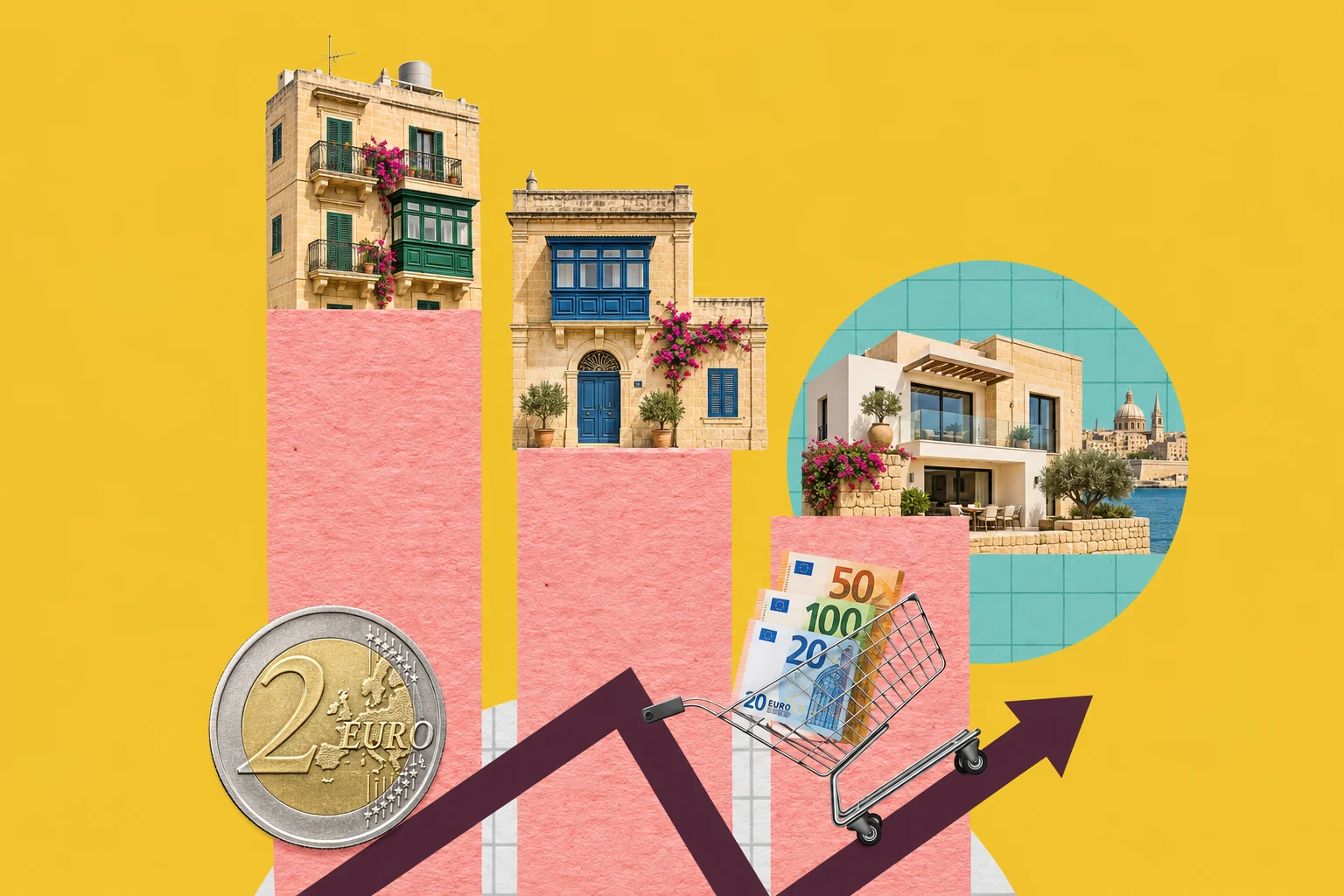
Malta's property market has reached a breaking point. For years, rising prices have been framed as a sign of economic success. But for many Maltese couples trying to take their first step onto the property ladder, the reality is far less optimistic. Affordability is deteriorating, competition is intensifying, and the dream of home ownership is slipping out of reach.
At the heart of the issue lies a structural imbalance. Malta is a small island with finite land, yet demand has surged not only from locals but from investors and a rapidly growing rental market catering to foreign workers and third-country nationals. This has created a distorted system where property is no longer primarily a place to live, but a financial asset to be maximised.
A young Maltese couple today is not just competing with another couple. They are often competing with investors calculating rental yield, not affordability. In many cases, a three-bedroom apartment is not priced for a family, it is priced for five or six individuals sharing rooms. The result is simple: native young families lose.
Government interventions so far have largely focused on demand-side grants. While politically attractive, these measures fail to address the root problem. In practice, they are absorbed into higher property prices, benefiting sellers rather than buyers. Malta's two most frequently cited concerns, overdevelopment and a declining fertility rate, are deeply interconnected with this crisis. A housing market that prioritises speculation over liveability makes it increasingly difficult for young people to envision raising a family. The reforms outlined here aim to address these structural problems permanently.
1. Structural Support for First-Time Buyers Through Financing Reform
Rather than lump-sum grants that inflate prices, government intervention should target the real long-term burden: financing. Subsidising mortgage interest payments on private bank loans would reduce monthly repayments over time, offering sustained relief that is less likely to be immediately capitalised into property prices.
More transformatively, the government could directly provide zero-interest loans to first-time buyers. This would allow ordinary Maltese families to access financing without the compounding burden of interest, significantly lowering the true lifetime cost of home ownership. Unlike grants, zero-interest lending directly strengthens purchasing power without stimulating speculative demand, bringing a shift from short-term political gestures to long-term structural reform.
2. Rebalancing Ownership and Eliminating Rent-Driven Corporate Models
A 2024 University of Malta study commissioned by the Housing Authority lays bare the structural imbalance. While around 80% of landlords own between one and four properties, the top 10–13% of landlords control approximately 40–43% of all rental properties on the island. The average holding of 2.7 properties masks extreme outliers, i.e. those owning entire portfolios and blocks, whose market power over pricing and availability is disproportionate to their number.
There is no justification for allowing wealthy individuals or investment entities to accumulate hundreds of residential properties and live off rental income while ordinary families are priced out. A system of proportional ownership, where holdings are capped in line with family size or genuine housing need, would ensure housing serves primarily as shelter rather than a vehicle for speculative accumulation.
The emergence of REIT-style vehicles in Malta following the introduction of a REIT framework in 2019 should be curtailed before it becomes entrenched. Allowing institutional, rent-extractive models to expand in the residential sector would accelerate the financialisation of housing and place further upward pressure on prices. Property companies should instead remain oriented toward a development-and-sale model, ensuring completed units circulate back into the ownership market rather than being locked into perpetual rental cycles. Practical mechanisms exist to achieve this rebalancing in a managed, non-disruptive way although they require political will to design and implement.
Addressing genuine rental needs: this is not an argument against rental housing as such. A regulated rental sector serving genuine transient needs (expat workers, students and those not yet in a position to buy) remains both necessary and legitimate. The goal is not to eliminate renting but to subordinate it to the primary purpose of housing: providing stable, accessible homes. The regulatory architecture already being built around short-lets, including zoning powers and conditional licensing, provides a ready-made template for extending similar controls to the long-term rental market, tying licence allocations to verified labour demand rather than speculative appetite.
3. Stemming the Flow: Reforming Malta's Population Growth Model
Perhaps the most consequential and least politically comfortable factor is the sheer pace of population growth. Since 2013, Malta's population has surged from roughly 422,500 to around 549,000 — an increase of over 126,000 people, or 30% in just over a decade. Virtually all of it has been driven by foreign nationals, whose share of the population has risen from roughly one in ten to nearly one in three. This growth has been the primary driver of residential demand.
If external demand continues unchecked, supply-side reforms risk being overwhelmed before they can take effect. Malta must pair housing reform with a deliberate, managed reduction in the pace of external population growth, prioritising skilled, genuinely needed labour over volume-driven economic expansion that serves corporate interests at the expense of the Maltese public.
The 3-Pronged Approach
None of these reforms will work in isolation. This article proposes a deliberate 3-pronged approach to restoring balance to Malta's property market:
- Supporting genuine buyers through meaningful financing reform that directly strengthens the purchasing power of first-time buyers and young Maltese families rather than inflating prices further.
- Discouraging speculation and property hoarding through proportional ownership caps, regulated divestment mechanisms, and a rental market tied to verified labour demand rather than unchecked yield-seeking.
- Stemming external demand by moving away from a volume-driven immigration and economic model that has placed unsustainable pressure on a finite island with finite housing stock.
Each prong addresses a distinct dimension of the same crisis. Helping first-time buyers without tackling speculation means more money chasing the same distorted market. Capping ownership without managing population growth risks those reforms being overwhelmed by demand. And reducing immigration without reforming ownership leaves the existing concentration of property intact. Only by pursuing all three simultaneously can Malta restore its housing market to its most fundamental purpose: providing stable, accessible, and genuinely affordable homes for the people who live, work, and raise their families here.
A Necessary but Difficult Shift
These measures challenge deeply entrenched interests. Property owners, investors, and companies will argue they are unfair or economically damaging. But the current trajectory is far more damaging.
If left unchecked, Malta risks creating a permanent divide between those who own property and those who never will. The uncomfortable truth is that the market is not broken; it is functioning exactly as designed. It rewards capital, speculation, and density over community, stability, and family life.
Political leaders have previously acknowledged that certain major reforms require cross-party alignment to carry out. This is one of those moments. The reforms outlined here will be resisted, criticised, and will come at a cost to those who have benefited from the current system. But they are widely recognisable as necessary if Malta is to remain a country where its people can realistically build a life, a home, and a family.
If there was ever a policy area that demands political courage over political convenience, this is it.