
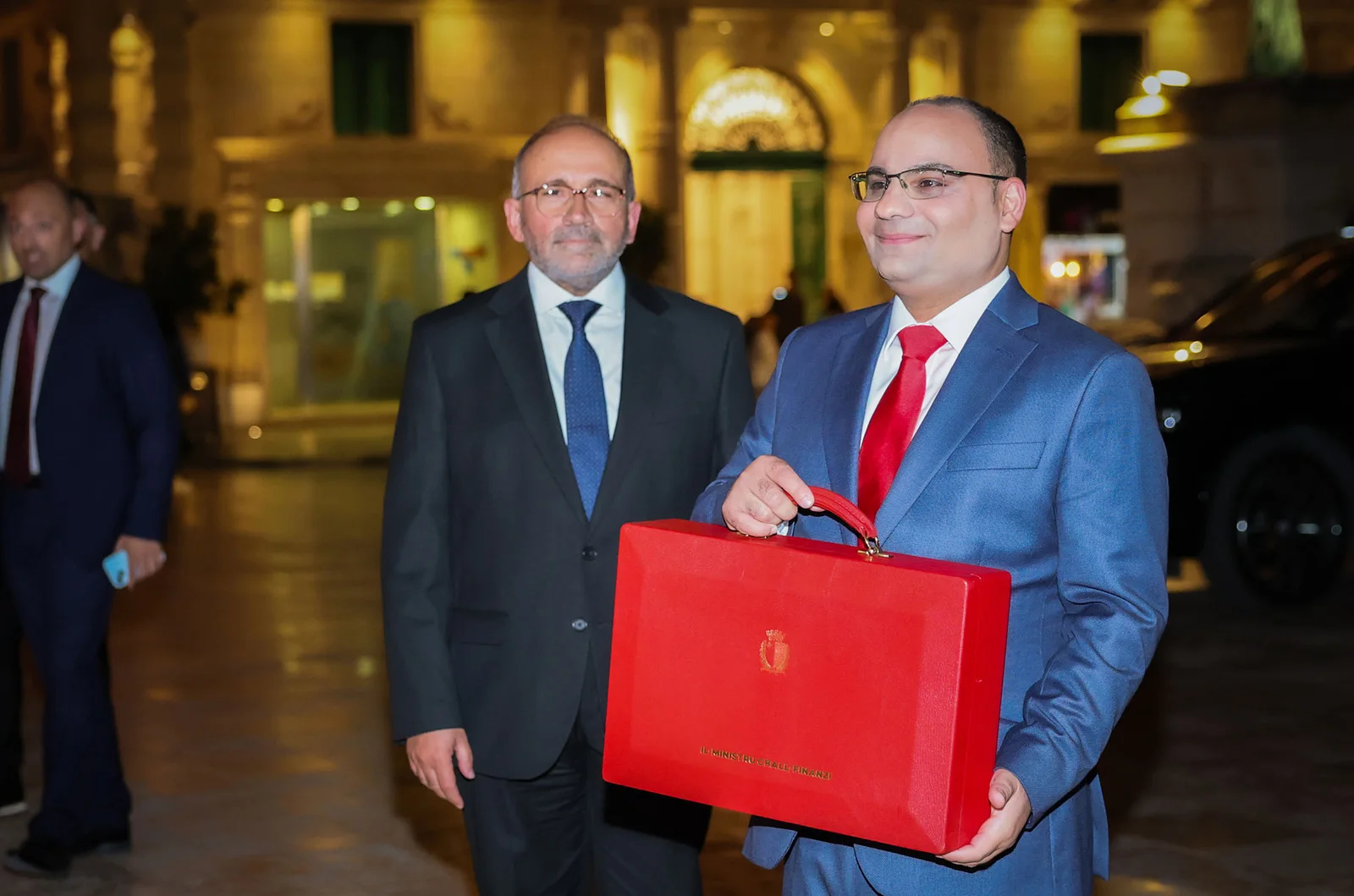
Budget 2027: A step in the right direction, but Malta’s economic debate must go further
The Budget signals a welcome shift in economic thinking. Yet its most important contribution may not be the money it distributes, but the questions it raises about Malta’s future.
Every October, Malta approaches the Budget with a familiar question: what am I going to get?
Whether it is a tax reduction, an allowance or a bonus, the public discussion often revolves around how much additional money households will receive.
There is nothing inherently wrong with expecting the Government to improve people’s living standards. But there is something concerning about judging an entire Budget primarily by how much money it puts into our pockets.
Government spending is not free money. It is financed by taxpayers, borrowing and other public revenues. Every euro distributed is a euro that could potentially have been invested elsewhere.
The question should therefore be broader: is the Government using our money in the most effective way possible?
This is the context in which Budget 2027 deserves to be assessed. And, on balance, it represents an encouraging step forward.
The Super Bonus: welcome, but what are we expecting from a Budget?
The Super Bonus was undoubtedly one of the Budget’s most anticipated measures.
Eligible workers will receive between €500 and €1,000, depending on their income. It continues a broader pattern of household support, following previous income tax reductions and more generous tax treatment for parents.
There is a strong argument in its favour.
Unlike conventional tax reductions, a direct payment can reach workers whose incomes are already too low for them to pay substantial income tax. In this sense, the Super Bonus can be more effective at supporting certain lower-income households.
But its popularity raises a different question.
Have successive Budgets conditioned us to expect a financial reward every October?
A Budget should not be reduced to an annual exercise in distributing money. Improving public services, investing in infrastructure and addressing structural economic problems can generate benefits that are less immediately visible but potentially far more valuable.
A €1,000 bonus is tangible. A more productive economy, shorter commuting times or more reliable electricity supply may be worth considerably more over time.
Both matter. But we should be careful not to judge the former more favourably simply because it is easier to quantify.
Why maintaining energy subsidies makes economic sense
One of the Budget’s most important decisions is the continuation of approximately €400 million in energy subsidies.
It is tempting to argue that such expenditure is unsustainable or that subsidies should be withdrawn to encourage investment in renewable energy.
However, Malta’s circumstances require a more nuanced assessment.
As a small island economy, Malta faces structural disadvantages that larger countries do not necessarily experience. We depend heavily on imported resources, have a limited domestic market and face additional costs associated with our geographical position.
Energy is also an essential expense. Households cannot simply stop consuming electricity when prices increase, while businesses cannot easily operate without it.
Maintaining stable energy prices therefore provides an important competitive advantage.
There is also the question of confidence.
When households and businesses have operated for years under a relatively stable energy-price environment, suddenly withdrawing support could create uncertainty extending beyond the immediate increase in bills.
Businesses make investment decisions based partly on expectations about future operating costs. Predictability has economic value.
Of course, subsidies should be scrutinised for waste and inefficiency. But removing them is not necessarily the most efficient solution.
Nor is renewable energy a simple substitute for the existing system. Renewable generation requires investment in grids, storage, backup capacity and system flexibility. A greater renewable share does not automatically guarantee cheaper electricity.
The stronger argument is therefore to maintain stability while improving efficiency and expanding Malta’s energy capacity.
Foreign workers: the Budget is no longer about incentives the stick finally makes an appearance
Perhaps the most politically significant aspect of the Budget is its approach towards third-country nationals.
New work-permit applications will become more expensive, while an additional annual infrastructure levy will apply. Certain foreign residents will also face restrictions on benefits and additional driving-related charges.
These measures have understandably generated considerable debate.
But describing them simply as an attempt to remove foreign workers misses an important economic distinction.
The Budget appears to favour retaining existing workers over continually recruiting new ones.
That matters because employee turnover carries costs. Businesses must recruit and train replacements, while workers need time to become familiar with their jobs.
Encouraging retention could therefore improve efficiency and reduce the pressure created by a constant cycle of recruitment.
There is also a broader question about Malta’s dependence on inexpensive labour.
Between 2015 and 2025, approximately 106,000 of the 130,000 additional workers in Malta were foreign nationals. That is around 82% of the net increase.
Foreign workers have made an enormous contribution to Malta’s economic success. The issue is not whether they are needed, but whether businesses should continue expanding primarily by employing more people.
Technological change makes this question increasingly urgent.
Artificial intelligence and automation are transforming activities that previously required human labour. Some tasks currently performed manually may soon be undertaken more efficiently by technology.
Malta has experienced economic transitions before, including the decline of industries that could no longer compete internationally.
The lesson is that economic change will not necessarily wait for us.
Rather than treating foreign workers as the problem, we should recognise that Malta has an opportunity to improve how businesses operate before global technological developments force that adjustment.
And importantly, this does not necessarily require replacing Malta’s entire economic model. It requires making the existing economy more efficient.
Higher labour costs may encourage that process. But they must be accompanied by investment, training and opportunities for businesses to modernise.
Tourism should pay for the costs it creates
The increase in tourism eco-contributions is another measure that deserves a more positive assessment than it might initially receive.
Hotel visitors will pay €8 per night, capped at €64, while short-let guests will pay €10 nightly, capped at €80.
There are two possible economic effects.
First, higher charges may discourage some price-sensitive tourists. If this reduces pressure on overcrowded destinations, that is not necessarily a negative outcome.
Second, even if tourist numbers remain unchanged, the Government will collect more revenue from an industry that creates costs extending beyond the businesses directly benefiting from it.
Economists describe these as negative externalities.
Tourism generates employment and income, but it also contributes to congestion, overcrowding, waste management costs and pressure on public infrastructure.
These costs are not always reflected in the prices paid by visitors.
An eco-contribution can help address that imbalance by requiring tourists to contribute more towards the public resources they consume.
This does not mean the Government can simply tax its way out of overtourism.
Nor should we assume that every additional euro of tourist expenditure necessarily improves residents’ quality of life.
For some people, a quieter beach or less congested town may be worth more than a marginal increase in national income.
That is an important economic consideration. Living standards are not measured by GDP alone.
The Government’s approach is therefore a welcome step, although more comprehensive tourism management will still be necessary.
Infrastructure: necessary, but not the complete answer
Budget 2027 also provides for capital expenditure approaching €1.5 billion, including additional investment in electricity distribution.
This is important. Malta cannot improve productivity without reliable infrastructure.
But the discussion should not end with the amount being spent.
Investment must translate into better services and reduced economic costs.
Transport provides a useful example.
Malta’s congestion problem is not exclusively an infrastructure problem. It is also an economic one, reflecting where people work, how they travel and the incentives influencing their choices.
Building additional roads may improve particular bottlenecks, but it does not necessarily address the underlying demand for car travel.
Greater investment in alternatives, particularly maritime transport following the success of existing ferry services, would strengthen the Government’s approach.
The same principle applies across the economy: we should assess public investment by its results, not simply by the amount allocated.
A welcome beginning, not the final destination
Budget 2027 deserves credit for addressing an issue that has increasingly dominated Malta’s economic debate: the sustainability of a growth model heavily dependent on additional labour and rising economic activity.
Its measures on foreign workers and tourism suggest a willingness to confront the pressures associated with that model, while household support and energy subsidies continue to provide stability.
There are areas where the Government could have gone further, particularly in encouraging investment, improving transport alternatives and addressing differences in the tax treatment of businesses.
But economic transformation does not happen through a single Budget.
Nor should we expect every structural problem to be solved in one evening.
The important thing is to establish the right direction and continue building on it.
Budget 2027 has taken a meaningful step in that direction.
Its real success will depend on whether Malta becomes more efficient, whether businesses invest in productivity, and whether economic growth translates into a better quality of life.
Because ultimately, the best Budget is not necessarily the one that gives us the most money today.
It is the one that leaves us better off tomorrow.
Photo: DOI, Alan Saliba