
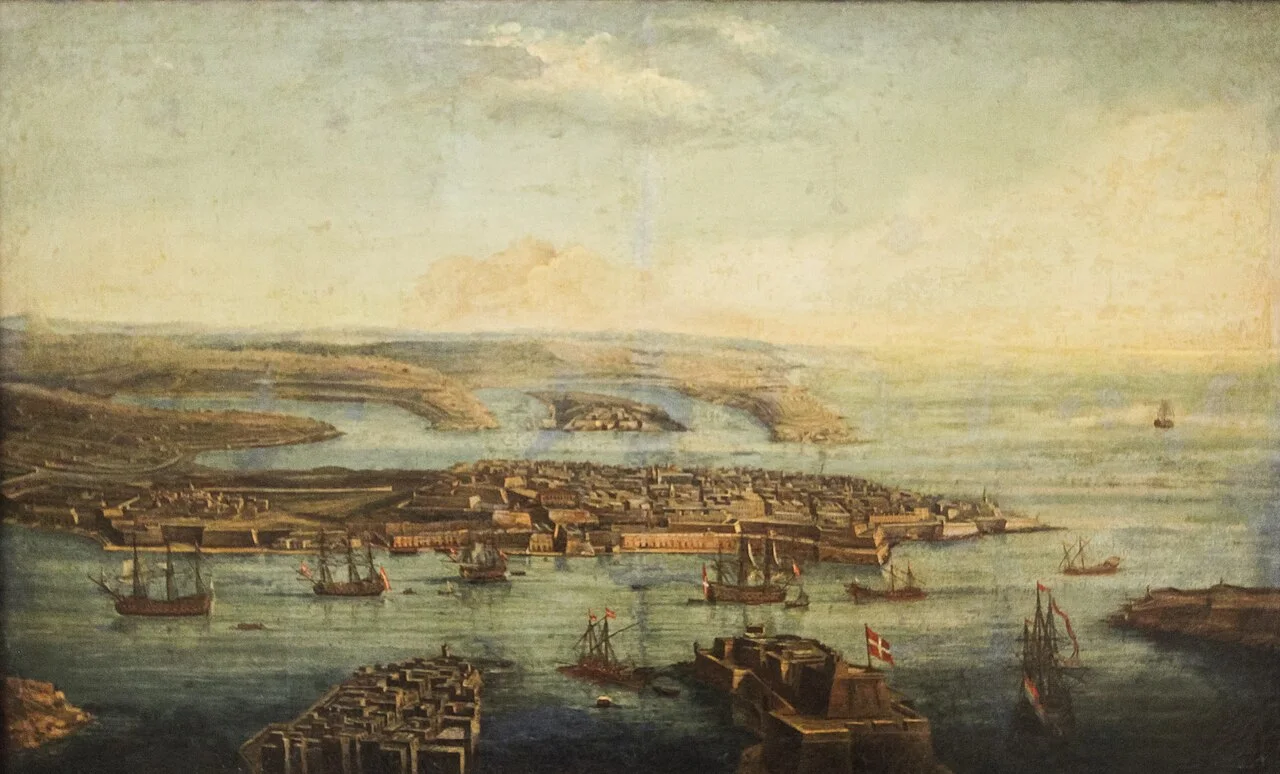
Malta’s public administration was not created in one definitive historical moment, nor was it transformed by one well-known reform. Its roots can be traced back almost 500 years. Each manifestation of Maltese government has inherited institutions, practices and problems from the one before it. Some structures disappeared, others were renamed, and many were adapted to new political realities. The result is an administration shaped by the Knights of St John, reorganised during the French occupation, formalised under British rule and recast after Independence. Its history shows that Maltese public administration has survived not by standing still, but by absorbing change while preserving institutional continuity.
The Knights built more than fortifications
When the Order of St John arrived in 1530, it needed an administration capable of financing defence and sustaining the islands. Its fortifications, roads, water systems and food supply all required planning and management.
The so-called Università of Valletta managed the grain trade. It controlled wheat imports, regulated markets and supervised prices, weights and quality (Sharp, 2009). This was public administration in its most practical form, keeping Malta supplied and preventing scarcity from becoming instability.
The Knights also developed infrastructure. The Wignacourt Aqueduct carried drinking water from the Rabat and Dingli area to Valletta and remained in use until the early twentieth century (Ellul, 2007). Healthcare expanded into a more organised system of social services (Savona-Ventura, 1999), including the Sacra Infermeria, which became an important centre for medicine and teaching. Another institution that stood the test of time was the Monte di Pietà, established in Malta in 1598 to provide affordable loans to people in need against gold, silver and other precious objects held as security. It survived several changes of government, and most recently operated within the Inland Revenue Department. Although it declined in relevance during the early 2010s, it did not entirely disappear. By January 2016, the value of goods being pawned had risen to its highest level in a decade, giving the centuries-old institution an unexpected revival (Micallef, 2016).
The brief French occupation of Malta added another layer to the overall administrative inheritance. A Commission of Government was established, and Malta and Gozo were divided into 12 cantons with their own administrators (Di Marco, 2013). Education was also reorganised, with plans for primary schools and a scientific Polytechnique.
Several institutions survived even under British rule. Institutions inherited from the Order, including hospitals, customs and the administration of public property were retained or restored (Pirotta, 1996). Eventually, the 1964 Independence Constitution transferred political authority to a sovereign Maltese state, but it did not sweep away the inherited machinery. In fact, it formalised the Maltese Public Service within the highest law of the land - the Constitution.
Who’s Behind Government?
Ask who forms part of Government and most people will name politicians. That answer is not wrong, but it does not paint a complete picture. Government combines political leadership, a permanent administration and a network of public institutions. Politicians choose priorities. Public employees turn those choices into programmes and services. Institutions provide specialised delivery and, in some cases, independent oversight.
A government may change after an election. The administration does not disappear with it. The Prime Minister assigns portfolios, while ministers set priorities and answer politically for their performance. This is government’s most visible layer. But ministers do not personally manage hospitals, issue permits, collect taxes or administer benefits. Behind them is an administrative structure led by public employees across multiple levels and functions. Political leadership without effective administration produces announcements that cannot be implemented. Administration without political direction lacks a democratic mandate.
What is not common knowledge is that Malta’s public administration actually has two broad branches: the Public Service and the Public Sector. The Public Service covers ministries and departments, or ‘central government’ including such examples as schools, hospitals and the police force. The wider Public Sector includes agencies, authorities and foundations. Examples include Aġenzija Żgħażagħ, the Malta Financial Services Authority and the Foundation for Social Welfare Services. This structure is extensively laid out and established by the Public Administration Act (2019). Understanding this distinction helps citizens and service users know which institution is responsible for a particular public service, where accountability lies, and how to direct requests. It also clarifies that bodies within the wider Public Sector may operate differently from government departments, with distinct responsibilities and legal personalities, governance arrangements and degrees of autonomy. This knowledge therefore enables citizens to navigate the state more effectively, access services through the appropriate channels and better understand executive functions.
The Maltese Public Administration: From Tradition to Reform
Malta’s Public Service is neither an old bureaucracy that resisted change nor one that has completely abandoned its roots. Its rules and hierarchies reflect a traditional model, while European membership has shaped its governance standards and digital systems are changing service delivery.
From the 1980s, the New Public Management model, which had close ties to neoliberalism, Thatcherism and Reaganism, took hold across many governments, bringing with it ideas borrowed from business: efficiency, measurable results, customer service, decentralisation and value for money (Pollitt, 2000). But government cannot simply operate like a business. It cannot abandon an expensive service or an inconvenient service user.
Current reforms, especially in technology, are now shaping the next generation of public services. AI-supported medical imaging is being used at Mater Dei Hospital and Gozo General Hospital to assist in diagnosing strokes and aneurysms, while intelligent transport systems are using AI-driven tools to manage traffic rerouting, road closures and urban mobility (OECD.AI, 2025).
Yet behind every law, licence, hospital appointment, classroom, road project or digital service, there are public employees translating policy into daily reality. Malta does not need to choose between the discipline of administration and the agility of reform. It needs both. The real test of reform is therefore not whether Malta abandons its administrative past, but whether it can use that inheritance wisely to build a public administration that is trusted, responsive and ready for the future.
References
Di Marco, E. (2013). The state of the Maltese economy at the end of the eighteenth century: Considerations based on the deeds of a local notary, Stefano Farrugia. Journal of Maltese History, 3(2), 91–100.
Ellul, M. (2007, February 3). Wignacourt aqueduct. Times of Malta. http://www.timesofmalta.com/articles/view/20070203/local/wignacourt-aqueduct
Micallef, K. (2016, January 1). Gold price may save Monte di Pietà. Times of Malta. https://web.archive.org/web/20160317234609/http://www.timesofmalta.com/articles/view/20160101/local/gold-price-may-save-monte-di-pieta.596850
OECD.AI. (2025). Public administration data strategy: Malta. OECD Artificial Intelligence Policy Observatory. https://oecd.ai/en/dashboards/policy-initiatives/public-administration-data-strategy
Pirotta, G. (1996). The Maltese public service, 1800–1940: The administrative politics of a micro-state. Mireva Publications.
Pollitt, C. (2000). Is the emperor in his underwear? An analysis of the impacts of public management reform. Public Management, 2(2), 181–199.
Savona-Ventura, C. (1999). Civil hospitals in Malta in the last two hundred years. Historia Hospitalium, 21, 45–63. https://www.um.edu.mt/library/oar/handle/123456789/23708
Sharp, P. R. (2009). Malta and the nineteenth-century grain trade: British free trade in a microcosm of empire? Journal of Maltese History, 1(2), 20–34.