
How Normal Was Malta’s Path to Independence?
On 21 September 1964, Malta became independent after more than 160 years of British rule.
The date places Malta squarely within the great wave of British decolonisation. India and Pakistan had become independent in 1947, Ghana in 1957, Nigeria and Cyprus in 1960, Jamaica in 1962 and Kenya in 1963. Malawi became independent two months before Malta, while Zambia followed just one month later.
In that respect, Malta was not exceptional at all. By the 1960s, independence had become the normal destination for much of what remained of the British Empire.
But there was never one standard road to independence. Some territories passed gradually from limited self-government to full sovereignty. Others experienced mass rebellion or even violence before Britain withdrew.
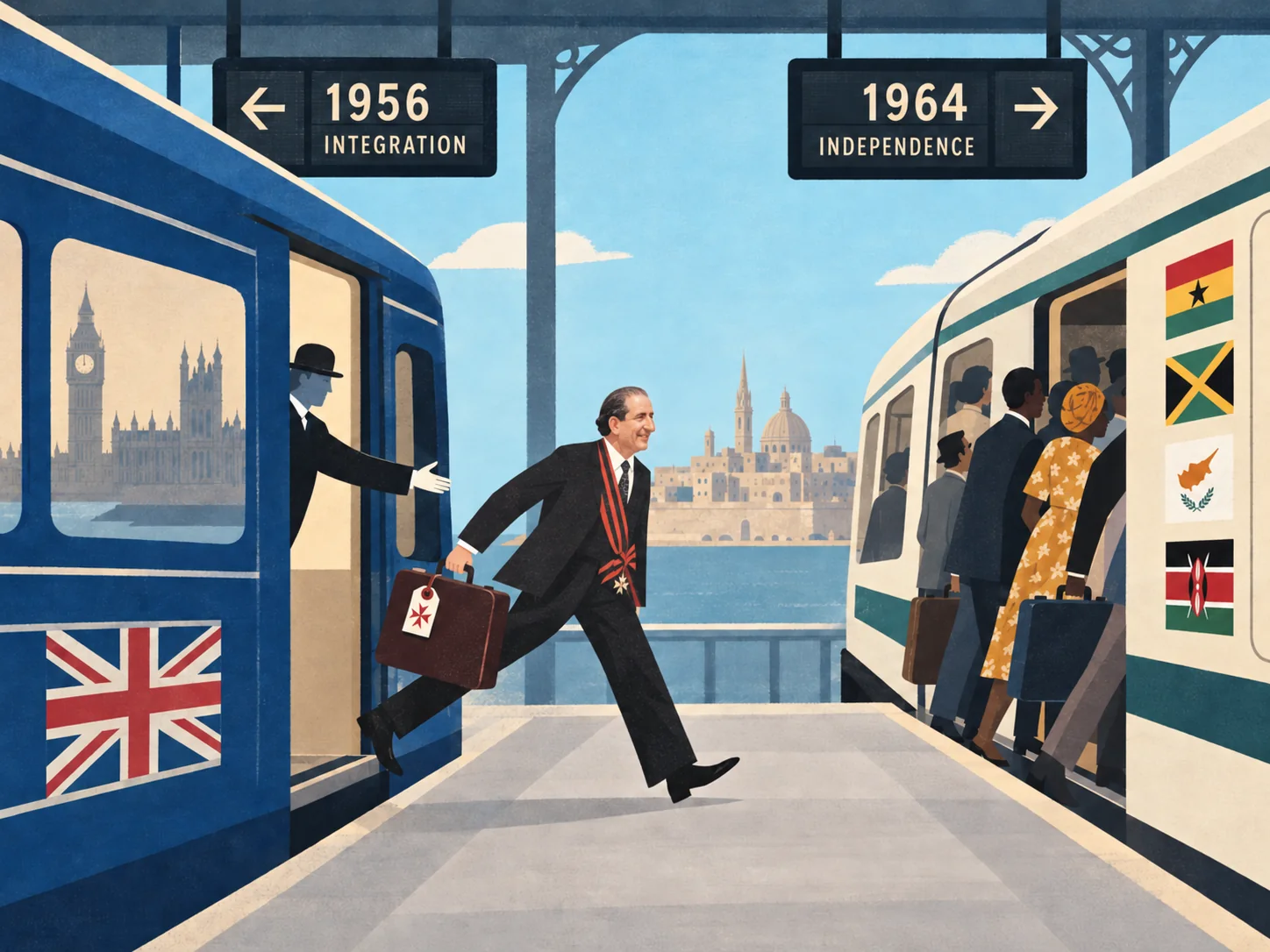
Malta shared elements with most of these cases. Yet one feature makes its path particularly unusual. Only eight years before independence, Malta was seriously discussing becoming more closely integrated into Britain rather than leaving it.
What did the “typical” British decolonisation process look like?
Perhaps the clearest example is Ghana. Ghana followed a relatively standard path: growing self-government, an electoral mandate for independence, negotiations with Britain, and independence in 1957. Jamaica’s story paints the same picture.
Malta’s final transition was also similar. After self-government was restored, George Borg Olivier’s government pursued independence in 1962, negotiated a constitution with Britain, held a referendum, and achieved sovereignty in 1964.
From 1962 onwards, Malta therefore looked fairly typical: an elected government sought independence, negotiated the constitutional terms, secured a political mandate, and entered the Commonwealth as a sovereign state.
What happened before 1962 is what makes Malta different.
Malta had first considered going in the opposite direction
While Ghana was progressing from colonial government towards self-government, and Jamaica was moving from self-government towards independence, Malta spent much of the 1950s considering whether the right path was to have representation inside the British political system.
In 1955, Dom Mintoff’s Labour government proposed a much closer constitutional relationship with the United Kingdom. The proposal was for Malta to retain its own legislature for domestic matters while also gaining representation in the British Parliament.
UK Prime Minister Anthony Eden regarded the idea seriously enough to establish a Round Table Conference specifically to study Malta’s future relationship with Britain and the proposal for Maltese MPs at Westminster.
The Conference ultimately recommended three Maltese MPs at Westminster.
The British government actually accepted the recommendations. In Parliament, the Colonial Secretary argued that Malta’s circumstances were exceptional and that its claim to Westminster representation was stronger than that of other colonial territories.
This gave Malta the opportunity to consider solving the colonial question by moving closer to the centre of the Empire instead of cutting ties.
That alone separates Malta from countries such as Ghana, Kenya or Jamaica.
The Maltese did not initially want independence
Malta’s political choice was more complicated. Most other colonies had to ask themselves when to become independent.
Before even going into that question, Malta first had to ask what Malta’s relationship with Britain should actually look like.
In fact, the Maltese electorate voted in favour of the integration proposals in February 1956.
Among valid votes, integration won comfortably but turnout was only around 60%, driven by a boycott by the Nationalist Party. Therefore, despite the results approving further integration with the UK, the low turnout allowed the opposition to claim that the result was inconclusive.
Britain said that Malta would have to demonstrate “clearly and unmistakably” that integration reflected the wishes of the population. This conclusion coincided with some British MPs expressing concern that the representation of Malta at Westminster would set a precedent for other colonies.
When integration collapsed in 1958, Malta’s constitutional direction changed rapidly.
Self-government was restored in 1962. Borg Olivier’s government pursued independence. The independence conference followed in 1963, the constitution went to referendum in 1964, and Malta became sovereign that September.
Within less than a decade, Malta had therefore moved from a referendum on full integration with Britain to an independent Maltese state.
Other colonies experienced much greater conflict
Malta also differed sharply from some other parts of the Empire because its path to independence did not involve an armed struggle against British rule.
In India, opposition to British rule had developed over decades. People like Gandhi organised mass protests, boycotts and campaigns demanding independence. When Britain finally left in 1947, independence also came with the split of India and Pakistan, widespread violence and the movement of millions of people across the new borders.
Kenya experienced a much more violent transition. In 1952, the Mau Mau rebellion began against British colonial rule, leading Britain to declare a state of emergency. Fighting, arrests and detention continued for years. Only after this period did Britain begin moving more quickly towards an African majority government, with Kenya eventually becoming independent in 1963.
Cyprus is perhaps an even more useful comparison with Malta. Both were small Mediterranean islands of major strategic importance to Britain.
But Cyprus’s struggle was far more violent. Between 1955 and 1959, the armed organisation EOKA carried out a guerrilla campaign against British rule. Its main objective was actually the union of Cyprus with Greece. Britain responded with arrests, military operations and the deportation of Archbishop Makarios, one of the island’s leading political figures. Cyprus eventually became independent in 1960 following negotiations involving Britain, Greece, Turkey, and representatives of both the Greek and Turkish Cypriot communities.
Malta certainly did have serious confrontations with Britain. There were protests, constitutional crises, bitter political disputes and, earlier in the century, the Sette Giugno riots of 1919, when British troops fired on Maltese demonstrators and killed four people.
But Malta never experienced anything comparable to the Mau Mau rebellion in Kenya or the EOKA campaign in Cyprus.
By the 1950s and 1960s, the struggle over Malta’s future was fought mainly through elections, negotiations, constitutional changes and political pressure, rather than an organised armed campaign. Malta’s eventual independence in 1964 was therefore overwhelmingly a negotiated transition.
In this sense, Malta’s road to independence had more in common with countries such as Ghana or Jamaica than with the violent conflicts seen in Kenya or Cyprus.
Like Malta, both countries experienced tension and confrontation with Britain, but their final transition to independence was largely constitutional rather than military.
Where Malta and Cyprus were similar: Britain still wanted the military relationship
Independence also did not necessarily mean Britain simply packed up and left.
Cyprus became independent in 1960, but Britain retained full sovereignty over the military areas of Akrotiri and Dhekelia. Those Sovereign Base Areas remain British territory to this day.
Malta reached a different arrangement but faced the same underlying issue: Britain’s military interest in the islands had to be reconciled with Maltese sovereignty.
When the final agreements were concluded in 1964, British forces were permitted to remain in Malta for ten years. Britain also agreed to provide approximately £50 million in financial aid over that period to assist economic development, diversification and emigration.
So Malta’s independence was not an immediate severing of its relationship with Britain.
This too was fairly normal.
Many newly independent British territories entered the Commonwealth, retained the Queen as head of state initially, maintained defence relationships with Britain or continued to depend heavily on British economic assistance.
Malta initially did all of these things.
So how normal was Malta’s path?
There was no single path out of the British Empire, but Malta’s independence in 1964 was broadly in line with what was happening elsewhere at the time.
What made Malta unusual was what came just before it. For several years, Malta was not simply moving towards independence. A serious alternative was being discussed: closer integration with Britain, including Maltese representation in the British Parliament.
When that project failed, Malta moved towards independence instead.
So Malta’s final destination was typical of British decolonisation in the 1960s. The unusual part was the route it took to get there.