
Malta’s 1904 Constitutional Crisis and the Politics of Mass Resignation
At the start of the twentieth century, Malta found itself in the middle of a constitutional confrontation that exposed the limits of colonial reform and the depth of local resistance to political rollback. The crisis of 1904, marked by three consecutive elections followed by coordinated mass resignations. This was a deliberate, organised act of protest against the imposition of the 1903 constitutional arrangements, known as the “Chamberlain Constitution”, which significantly reduced the power of elected Maltese representatives.
This episode is often treated as a footnote in Malta’s constitutional history but, in reality, it was a pivotal moment in the development of Maltese political consciousness and a clear demonstration that constitutional legitimacy could not be sustained by administrative authority alone.
Malta’s Constitutional Trajectory Before 1903
By the late nineteenth century, Malta had already experienced several cycles of constitutional expansion and contraction under British rule. Since the mid-1800s, the island had gradually moved away from pure Crown Colony governance towards limited representation through the Council of Government. These reforms were always cautious and controlled, but they created an expectation that political participation would deepen over time.
The 1887 Constitution, often referred to as the Knutsford Constitution, was the best one of this phase. It expanded the number of elected members and gave them real leverage in legislative and financial matters. While the Governor and appointed officials retained important powers, elected representatives could block budgets and influence policy. This gave Maltese political actors a tangible sense of agency in their own country’s matters.
At the same time, political life in Malta was shaped by deep cultural and linguistic tensions. The so-called “language question” was a struggle over identity, alignment, and power. Italian had long been the language of law, culture, and the educated classes. British authorities increasingly pushed for English as the language of administration and education. This was seen by many Maltese not as neutral modernisation, but as cultural displacement.
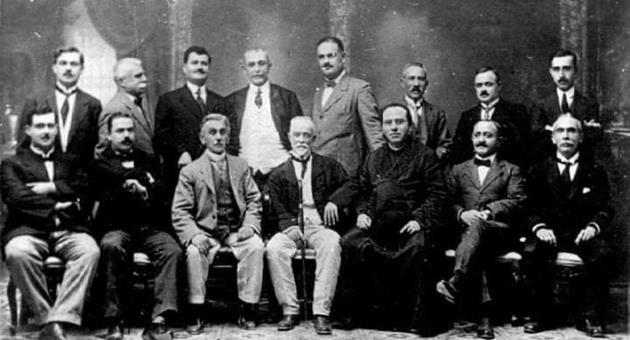
By the turn of the century, relations between elected members and the colonial administration had become increasingly strained. Elected representatives frequently resisted education policies, budgetary priorities, and administrative reforms that they believed undermined local interests or traditions. This was partly because the electorate itself was drawn from the social elite. Voting rights were limited to property owners and professionals, many of whom were culturally aligned with Italian language and traditions and consistently supported pro-Italian political parties. These representatives therefore reflected not only a linguistic preference, but also the interests and worldview of Malta’s upper social strata.
From London’s perspective, Malta’s legislature had become obstructive. From Malta’s perspective, it was exercising the limited powers it had been given. This tension set the stage for the 1903 rupture.
The 1903 “Chamberlain” Constitution
In 1903, under the authority of Joseph Chamberlain, the British Secretary of State for the Colonies, the 1887 Constitution was revoked. It was replaced with a new constitutional framework that fundamentally altered the balance of power within the Council of Government.
The key change was structural in which the number of elected members was reduced to eight, while appointed officials and the Governor were given a permanent majority. This meant that, regardless of how united or determined elected members were, they could always be outvoted. The council ceased to be a body where local representatives could meaningfully shape outcomes. It became, in effect, an advisory chamber.
The justification from London was administrative efficiency. The argument was that Malta’s legislature had become dysfunctional, that budgets were being blocked, and that essential reforms were being delayed. The solution, in the eyes of the Colonial Office, was to restore firm executive control.
For Maltese political leaders, this was a political regression. Rights that had been gained over decades were removed in a single stroke. The promise of gradual self-government was replaced by a model that made elected participation largely symbolic.
The anger was not only about power. It was also about process. The change was imposed unilaterally. There was no negotiation, no local mandate, and no meaningful consultation. To many Maltese, this confirmed a suspicion that constitutional progress was conditional and reversible whenever it conflicted with imperial priorities.
The January 1904 Election and the First Resignation
General elections were held on 14 January 1904 under the new constitution. In theory, this was meant to restore normal legislative functioning. In practice, it became the first stage of organised resistance.
Only one candidate stood in each of the eight districts. All were elected unopposed. They were aligned with the Partito Nazionale and the broader anti-reform movement that rejected the new constitutional order.
Immediately after being elected, all eight resigned their seats. This was coordinated, premeditated, and symbolic. The message was clear. The issue was not who held the seats. It was the legitimacy of the seats themselves. By refusing to take part, the elected members denied the colonial administration the appearance of constitutional normality. The Council of Government was left without any elected Maltese representatives.
February and April 1904: Repetition and Escalation
The British response was very procedural. Fresh elections were called in February 1904. The logic was straightforward. If representatives resigned, they would be replaced. The result was identical. Once again, candidates were elected unopposed. Once again, they resigned immediately.
A third election was held in April 1904. The same pattern repeated. By this point, the protest had become unmistakable. This was active non-cooperation. The Maltese political class was using the only tool available to it to signal rejection of the constitutional framework. The repeated resignations created a political vacuum. The Council of Government continued to exist, but without elected members it was exposed for what it had become: a body dominated entirely by colonial officials.
The Aftermath and the Long Road Forward
After the third resignation in April 1904, the colonial authorities did not immediately call further elections. The strategy of forced replacement had failed. Malta was effectively governed without elected representation until 1907.
This did not mean the protest succeeded in restoring the old constitution. It did not. The 1903 framework remained in place. But the episode left a mark. In the longer term, the crisis fed into the broader movement for self-government. The experience of being sidelined reinforced demands for real autonomy, not decorative participation would eventually contribute to the constitutional settlement of 1921, which granted Malta a measure of self-government with an elected legislature and responsible ministers.
The road from 1904 to 1921 was not direct, and it was shaped by global events, particularly the First World War. But the logic was already present. Once a political community experiences representation, the removal of that representation is not easily accepted.