
The First Italian TV program is transmitted in Malta 1957
On this day in 1957, Malta successfully received its first live television transmission from Italy.
The Times of Malta reported that the previous evening, radio mechanic Frank Bonnici, working with A.J. Vella, the local agent for PYE Radio and Television, managed to capture a television signal transmitted from Monte Pellegrino and Monte Soro in Sicily. The reception was described as “good already”, a notable technical achievement given the equipment and conditions of the time.
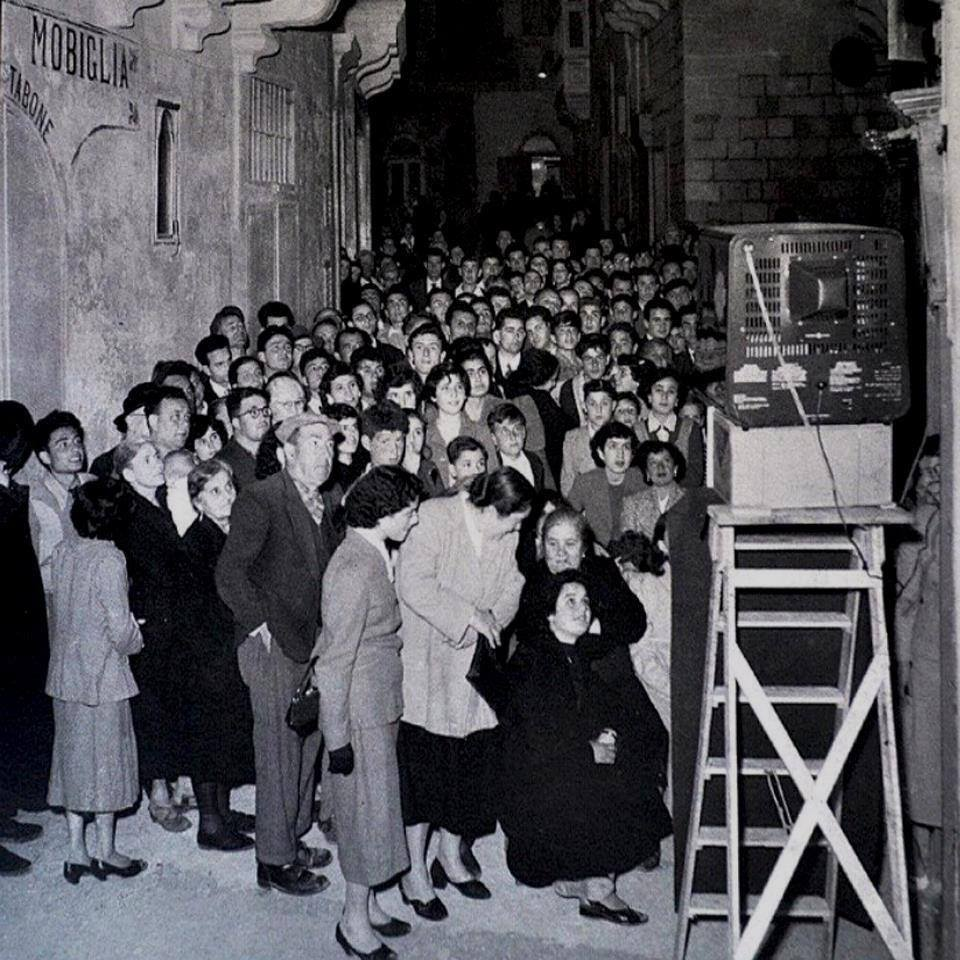
Maltese gather around to watch TV for the first time
This was not a government project or a formal launch. It was a private technical experiment driven by individual initiative and commercial curiosity. To demonstrate that the signal had been received, the television set was placed in the shop window of the Electro Store in Zachary Street, Valletta. People gathered in the street to watch moving images coming from another country. For most Maltese, this was the first time they had ever seen live television.
Within weeks, advertisements for television sets began appearing in local newspapers.
Brands such as PYE, Philips, Grundig, Telefunken and Ferguson entered the Maltese market. A 17-inch television cost around £105, while a 21-inch model sold for approximately £125. At a time when average weekly wages were about £6, this represented a significant investment. Despite this, interest was strong, and dealers invited the public to come and watch television in their showrooms every evening.
Reception, however, was uneven. Low-lying areas struggled to receive a clear signal. There were calls for a local relay station to improve coverage. There were also technical uncertainties. Britain was still using a 405-line system, while most of Europe had moved to the 625-line standard. Consumers questioned whether the sets being sold would be future-proof. Even in its earliest days, television in Malta arrived with limitations and doubt.
The social context is important. Malta in 1957 was still rebuilding from wartime devastation. Employment was improving but insecurity remained. Politically, the island was in turmoil over the proposed integration with Britain. Public debate was tense and polarised. Cinemas were the dominant form of mass entertainment, and cultural life was largely local and insular. It was into this unsettled environment that television quietly entered.
What followed was not just a new form of entertainment, but a structural shift in how Maltese society related to the outside world. For the first time, voices from abroad came with images. Italian news, culture and lifestyle entered Maltese homes. The psychological distance between Malta and mainland Europe narrowed. Local communities were no longer sealed off by geography alone.
This moment matters because it marks the beginning of Malta’s visual integration into wider cultural and social currents. Radio had already connected the island to external voices, but television made comparison unavoidable. Ways of living, speaking, dressing and thinking could now be seen, not just imagined. The local and the foreign were placed side by side in real time.
It is tempting to treat this as a simple story of technological progress. That is too narrow. Television did not only modernise Malta. It also accelerated cultural pressure. It imported aspirations that the local economy and social structures were not always ready to meet. It reshaped expectations about lifestyle, politics and identity. In a small, open society, these influences travel fast and embed deeply.
Seen in this light, 12 January 1957 is not just a milestone in broadcasting history. It is an early example of how external media can transform internal culture in Malta. Long before the internet, long before social media, the island was already being reshaped by images from abroad.
The technology has changed. The dynamic has not.
Source - Times of Malta - https://timesofmalta.com/article/italian-tv-signal-transmitted-successfully-to-malta-65-years-ago.927094