
Um El Faroud Explosion: Malta’s Deadliest Industrial Tragedy
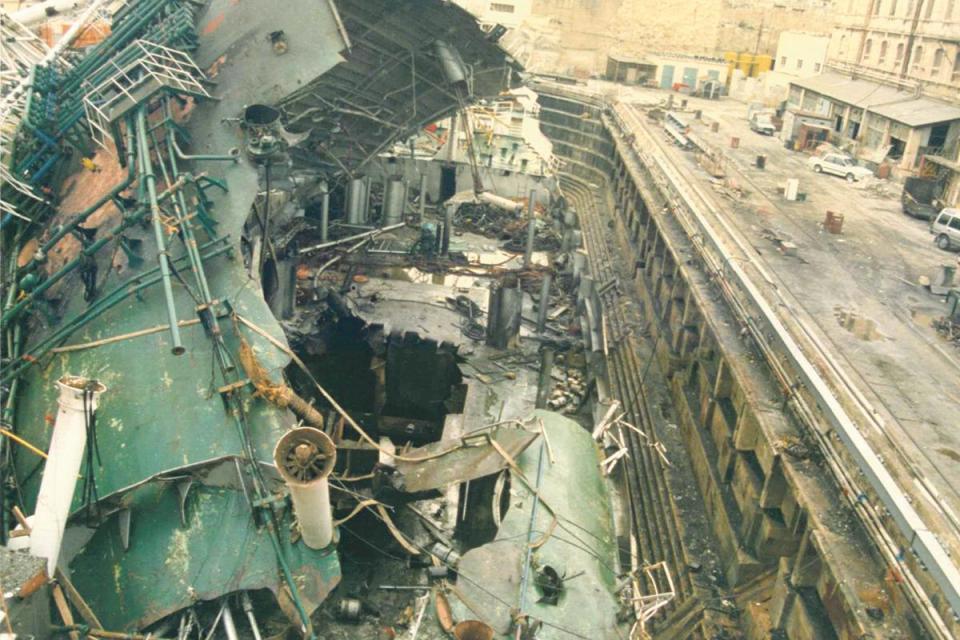
On 3 February 1995, a routine industrial operation at the Malta Drydocks turned into one of the island’s deadliest tragedies. The oil tanker Um El Faroud, already written off after years of service and damage, was being prepared for controlled demolition ahead of its planned sinking at sea. Instead, a powerful explosion ripped through the vessel, killing nine men, six dockyard workers and three Civil Protection firefighters, and injuring others nearby.
The blast was immense. Witnesses reported hearing it across large parts of the island, while debris was hurled hundreds of metres from the dockyard. A fireball engulfed the ship, shattering nearby structures and instantly turning a technical operation into a mass-casualty event. Emergency services rushed in, only to be confronted with a chaotic scene of fire, twisted steel, and devastation inside what was meant to be a controlled environment.
Almost immediately, questions arose over how such an explosion could occur. The Um El Faroud explosion was a result of flammable gases and residues still inside the vessel, and investigations later pointed to serious failures in safety procedures, risk assessment, and coordination during the preparation works. Public anger focused not only on the immediate causes of the blast, but on broader issues of industrial culture, shortcuts, assumptions, and a tolerance for risk that had become normalised in heavy industry at the time.
The tragedy also marked a turning point in public awareness. For many Maltese, the explosion shattered the idea that industrial accidents were distant or unavoidable. It exposed the human cost of weak enforcement and poor oversight, and intensified calls for stricter safety standards at workplaces handling hazardous materials. Yet, as with many such moments, reform came slowly and unevenly.
After the explosion, investigations dragged on for years and no single figure was ever clearly held politically or institutionally accountable. For many families, the lasting wound wasn’t just the loss, but the sense that responsibility dissolved into committees, reports, and procedural fog. That frustration is part of why the tragedy still resonates.
Two years later, what remained of the Um El Faroud was finally scuttled off Wied iż-Żurrieq, resting on the seabed as an artificial reef. Over time, it became one of Malta’s most famous dive sites, a place now associated with marine life, exploration, and tourism. That transformation, however, sits uncomfortably alongside its past. Beneath the calm waters lies a wreck forever linked to a preventable disaster and the nine lives lost on that February day.