
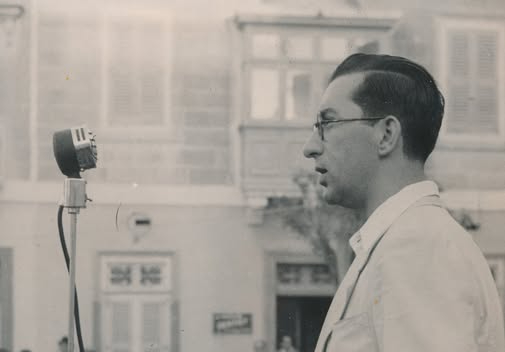
Dom Mintoff wins 1955 election
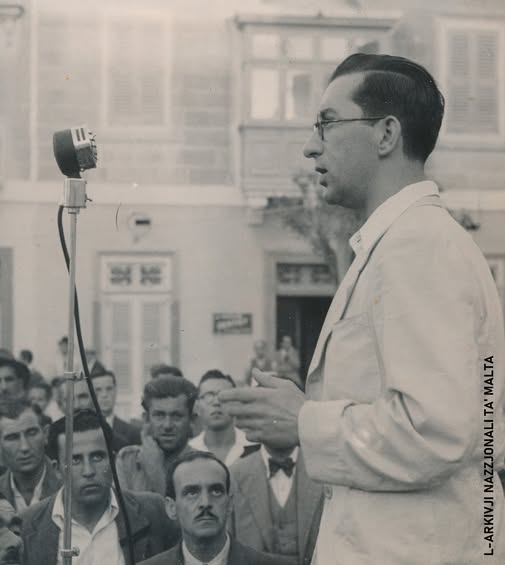
On 27 February 1955, Malta was in the middle of a three-day general election (26–28 February) that would end with Dom Mintoff’s Labour Party winning a clear majority, and with it, the mandate that would carry Mintoff into Castille as Prime Minister for the first time a couple of weeks later. He was sworn in on 11 March 1955.
To understand why this moment mattered, you have to picture Malta in the mid-1950s: still a British colony, still shaped by the aftershocks of war, and economically tethered to the British defence presence. Politics wasn’t just “left vs right”, it was a fight over what Malta was and what it should become: a self-governing colony, a fully independent state, or something more unusual.
The 1955 election result was decisive: Labour took 23 of the 40 seats, with the Nationalists on 17. That majority put Mintoff, Labour leader since 1949, in charge of government for the first time.
But Mintoff wasn’t walking into office with a “steady as she goes” programme. His flagship project was integration with the United Kingdom, not in the vague sense of “closer ties”, but in a concrete, constitutional sense: Malta would seek representation in Westminster and, crucially, aim for “economic equivalence” with Britain (the idea that Maltese living standards and social benefits should be brought up toward UK levels).
That pitch was powerful because it spoke directly to bread-and-butter reality: wages, work, social protections, and the island’s dependence on the British strategic economy. But it was also politically explosive, because it collided with two forces that could make or break any Maltese government at the time, London and the Catholic Church. London because it would have to pay, and the Church because of the social, religious and moral implications of the route Malta took.
Malta’s Church was not a background institution in the 1950s, it was a central political actor. Under Archbishop Michael Gonzi, it took an overt stance on the defining issues of the period, including integration, and repeatedly found itself in open conflict with Mintoff and Labour.
This wasn’t just theological sparring. It shaped votes, legitimacy, and the ability of any government to govern. Mintoff’s rise to power in 1955 therefore wasn’t merely “a new PM”; it marked the start of a phase where Malta’s constitutional future, living standards, and the Church-state balance were all being argued at maximum volume.
Mintoff’s first term until 1958, burned bright and ended abruptly. The integration project became a tug-of-war over cost, sovereignty, and who would ultimately control Malta’s direction. British willingness to entertain integration waned as the price tag and the political complications became clearer, while Mintoff pressed hard on “equivalence” as the minimum acceptable outcome.
The breakdown did not stay confined to negotiations. By 1958, the situation had deteriorated into a major political crisis: an emergency was declared and Malta moved back toward direct rule, the dramatic end of the first Mintoff premiership and a sign that the post-war constitutional arrangement simply wasn’t stable enough to contain the pressures building up.
Even though this “first time in Castille” ended in confrontation, it mattered because it changed Malta’s political geometry. It proved Labour could win and govern and it set patterns of hard negotiation and high-stakes constitutional bargaining. These themes would echo into the independence era.
Mintoff himself didn’t disappear. He returned to power in June 1971 and remained one of the defining architects of modern Malta’s political settlement.