
Why is less money being donated to l-Istrina?
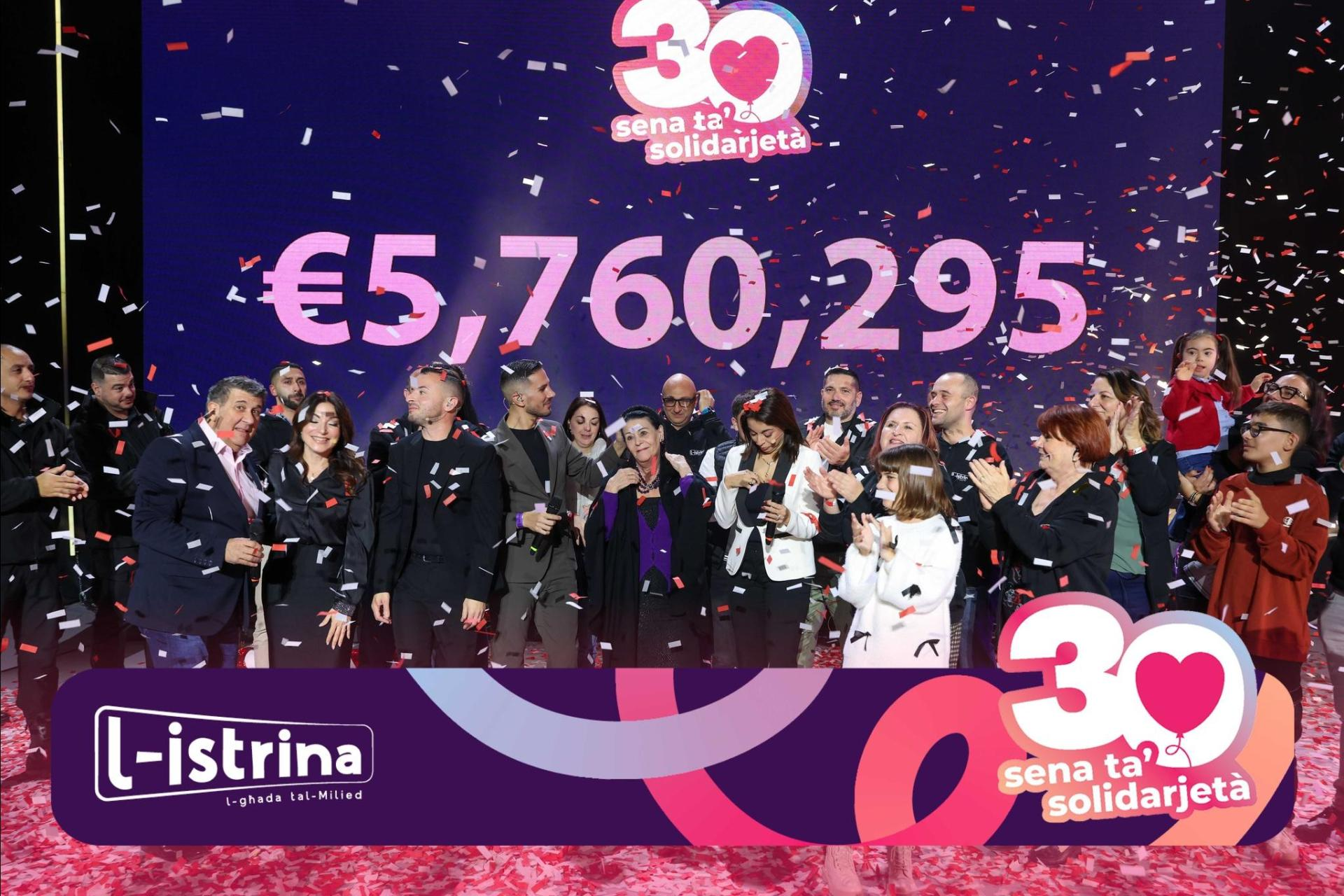
L-Istrina remains one of Malta’s most visible expressions of collective solidarity. Yet since 2021, fundraising totals have averaged €5.4 million, significantly short of the 2018 peak of €7.1 million. Since then, the economy grew substantially. 2024 GDP per capita stood at €40,620, a 43% increase from the €28,240 registered in 2018, and yet, l-Istrina fundraising flatlined. This has prompted questions about whether Maltese generosity itself is waning.
Research on telethons and mass-participation charity events suggests a simpler explanation. Fundraising outcomes tend to reflect household sentiment and perceived financial comfort, rather than headline figures related to GDP. Peaks are often driven by exceptional conditions, while subsequent years revert toward more sustainable levels.
When households feel financially comfortable, donation sizes tend to rise. When caution sets in, people do not stop giving altogether, but they give less. Because l-Istrina relies on thousands of small, voluntary contributions, modest changes in sentiment can translate into large movements in aggregate totals.
Seen in this light, fluctuations in l-Istrina’s totals are not anomalous, but predictable and explainable. To understand the shifts in l-Istrina donations, we need to look at two measures that inform us about household financial security in Malta; inflation in essential goods and consumer confidence.
Inflation is meant to describe how prices are moving across the whole economy. But most people don’t experience inflation through statistics. They experience it at the supermarket. A household buys food every week, sometimes every day, but might only buy things like candles, electronics or furniture once in a while. So even if the price of a candle falls sharply, it barely registers. If the price of bread, milk or vegetables goes up by a little, people notice immediately. Because these are the prices they see most often. That is why rising food costs tend to shape how inflation is perceived, even if general inflation is taking a completely opposite trend.
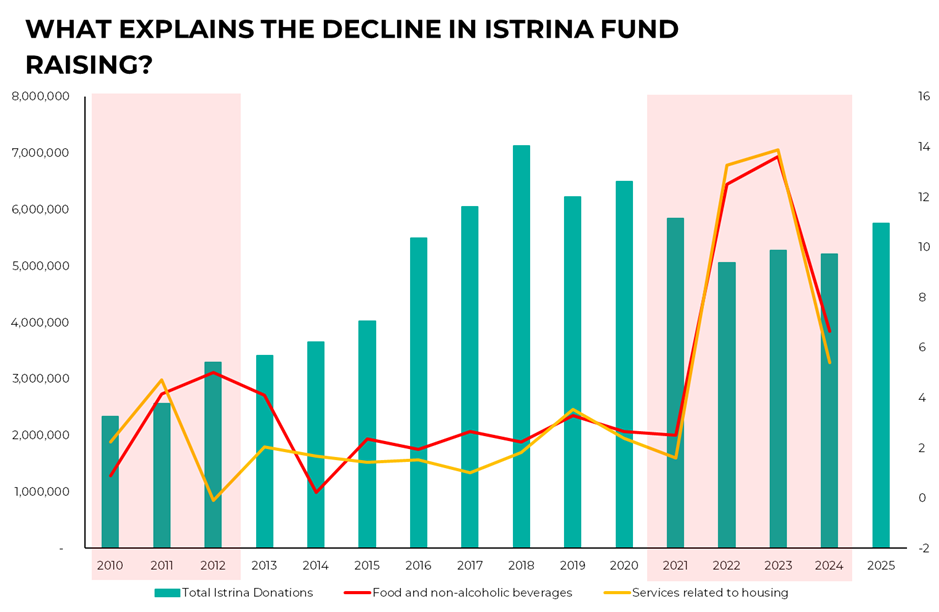
Between 2010 and 2018, inflation in food and housing-related services remained contained. Food inflation fluctuated mostly between 0% and 5%, while housing services inflation rarely exceeded 2%. The general perception was that cost of living was not a matter of concern. Even as Malta entered the pandemic, 2020 saw a total of €6.5 million Istrina donations.
But in 2021, and especially from 2022 onwards, food inflation surged into double digits, exceeding 12% in 2022 and nearly 14% in 2023. Inflation in housing-related services followed a similar trajectory, averaging almost 11%. These sudden and highly visible shocks to everyday expenses were immediately reflected in Istrina totals, which fell to their lowest levels since 2016.
Increasing grocery bills make households uneasy. This is reflected in the Consumer Confidence Index (CCI), which is a monthly survey-based measure of how people feel about their own finances. It captures whether households are optimistic or pessimistic about things like their income, job security, ability to save, and the general economic outlook over the months ahead. A positive means that people are generally optimistic, while a negative CCI indicates general pessimism or fear.
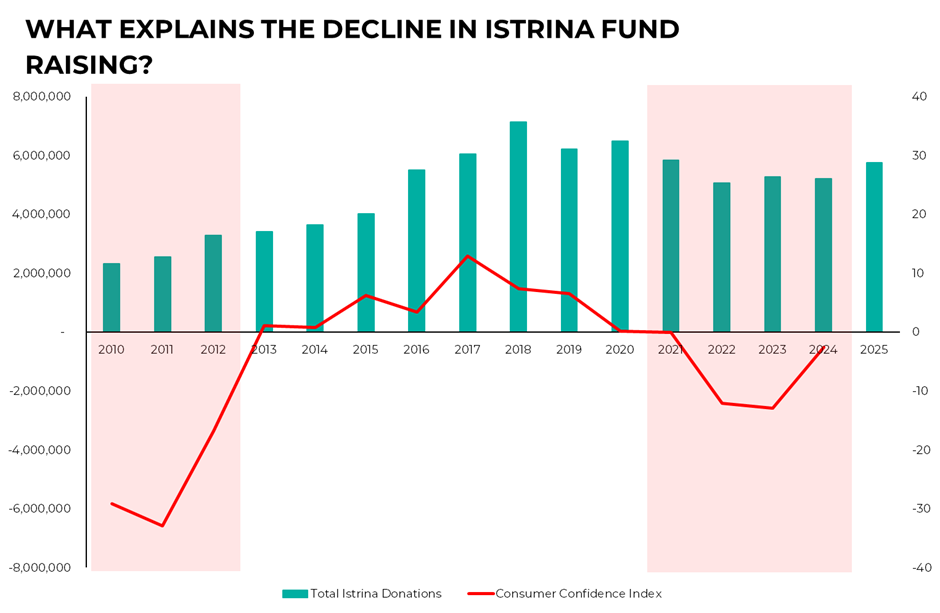
If we also compare Istrina totals to Malta’s Consumer Confidence Index, a clear pattern emerges. Periods of rising confidence tend to coincide with stronger fundraising outcomes, while periods of negative confidence align with stagnation or decline. The relationship is not mechanical, but it is consistent.
The CCI was positive between 2013 and 2015, and sure enough donations increased. The strongest growth phase coincided with the period of highest confidence between 2016 and 2018, culminating in the 2018 peak. When COVID-19 reached Malta in 2020, the CCI fell to almost zero, turning negative in 2021. Sure enough, we see l-Istrina totals declining with lower CCI results.
Four years of negative December CCI values followed, with totals struggling to reach 2016 levels despite economic growth and low unemployment. The 2025 recovery in l-Istrina donations may be an early signal of a positive December CCI for the first time since 2020.
Furthermore, l-Istrina takes place in December, a month where consumer confidence in Malta tends to be weaker, reflecting year-end budget fatigue, higher seasonal spending and a shift from optimism to financial stock-taking. This exposes l-Istrina to weaker sentiment even in otherwise favourable years. This makes peak outcomes the exception rather than the benchmark.
Taken together, the evidence points to a simple conclusion. L-Istrina fundraising is closely linked to consumer confidence, not because optimism creates generosity, but because pessimism restrains it. In this context, the decline from the 2018 peak reflects a prolonged period of weaker confidence rather than any erosion of solidarity. At the same time, stable food inflation and high consumer confidence between 2016 and 2019, created the perfect conditions for l-Istrina to bloom and reach the record sum of €7.1 million in 2018.
Despite lower Istrina totals, the Maltese remain one of the most generous people in the world. We know this thanks to the World Giving Index (WGI), published annually by the Charities Aid Foundation. The WGI measures how people around the world engage in charitable behaviour. It is based on survey data from the Gallup World Poll and captures the share of respondents who, in the past month, have donated money to charity, volunteered time to an organisation, or helped a stranger. These three components are combined into a single index.
On important thing to understand is that the WGI measures participation rather than the amount given: a small donation counts the same as a large one, and informal acts of help are weighted alongside formal charitable contributions. As a result, the index reflects patterns of generosity and social behaviour rather than total fundraising volumes.
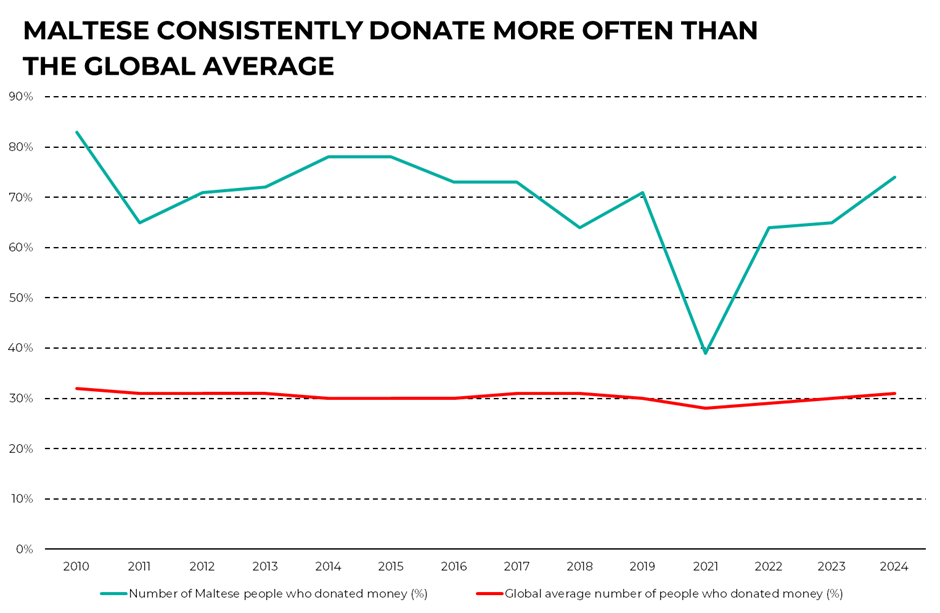
Taken as a whole, Malta’s performance in the World Giving Index is consistently strong by international standards. Over a fifteen-year span, Malta repeatedly places within or close to the global top tier, particularly on donating money, which remains its most stable and distinguishing strength. Even when overall rankings fluctuate, participation in giving rarely collapses outside exceptional circumstances. This points to a structural rather than episodic generosity. In fact, since 2010, an average 78% of Maltese reported to have given a monetary donation, way above the global average of 31%.
CAF’s reports emphasise that high WGI scores are not primarily driven by income levels or economic size. Instead, they reflect social norms, cultural expectations, and ease of participation in giving. Malta fits this profile closely. As a small, socially dense society, giving is highly visible and socially reinforced. Donations are not abstract acts carried out at a distance, but are closely tied to identifiable people, institutions, and causes. This social proximity lowers the psychological cost of giving and raises participation.
Another recurring theme in the reports is the importance of formal donation channels. Countries that perform well tend to have trusted, widely recognised mechanisms for monetary giving. Malta’s consistently high scores for donating money suggest that charitable giving is both normalised and institutionally embedded. Participation remains high even when other behaviours, such as volunteering time or helping strangers, fluctuate. This is consistent with CAF’s observation that monetary giving is the most resilient form of generosity in societies with strong institutional trust and clear giving pathways.
CAF also notes that generosity tends to be higher in countries with strong communal identity and shared social reference points. Malta’s size and cohesion amplify this effect. National moments of giving, collective appeals, and community-based charities are more likely to mobilise large shares of the population. This helps explain why Malta performs particularly well in donation participation compared to larger, more fragmented societies where giving is more individualised.
All in all, evidence does not point to a loss in Maltese generosity. It is only a case of a combination of high food inflation and weak consumer confidence, two factors that are temporary in nature. The generous Maltese heart is still alive and kicking.