
Aidan’s Bella was the right choice for Malta.
Eurovision doesn’t reward the average. It rewards contrast
The trap many Eurovision followers fall into is believing that “standing out” means “being weird.” The winners usually aren’t just weird. While being very different, they also carry a very clean execution.
Eurovision can feel wildly diverse, but listening closely reveals a large non-winning middle, where songs feel as if they are engineered in the same studio. The reason is simple: Eurovision is not just a music contest. It is a competitive market where countries learn from what worked last year, copy parts of it, and then fight for attention in an overcrowded field in the next year. That process has been studied academically. “Breaking the Code: Multi-level Learning in the Eurovision Song Contest” documents a pattern where the majority of participants will converge to a style that is similar or based on previous winners, while those handful that standout in terms of either talent, execution, sound or authenticity are rewarded.
Statistics show that in the last five Eurovision contests, a pattern emerges that is difficult to dismiss:
- 4 out of 5 winners came from minority genres
- Only 1 out of 5 winners came from the dominant genre (2023)
- In every year, pop/dance-pop/ballads made up ~60–70% of the field
2021 - Måneskin’s “Zitti e buoni”
In 2021, Italy won with Måneskin’s “Zitti e buoni”, a raw rock entry in a year where roughly 70–75% of songs could be classified as pop, dance-pop, or pop-ballads. Rock accounted for no more than three out of thirty-nine entries — around 8% of the field. The winner came from that minority.
- Pop / Dance-pop / Ballad (broad pop family): 28 songs (72% of participants)
- Rock: 3 songs (8%)
- Folk / Ethno: 4 songs (10%)
- Other / Hybrid: 3 songs (8%)
Rock was the winning genre and also a clear minority.
2022 - Kalush Orchestra’s “Stefania”
In 2022, Ukraine’s Kalush Orchestra won with “Stefania”, a folk-rap song. Again, the numbers matter. Of roughly forty competing songs, around two-thirds sat firmly in the pop or dance-pop family. Folk-influenced entries numbered perhaps three or four, and rap-forward tracks fewer still. The winning genre represented well under 10% of the field.
- Pop / Dance-pop / Ballad: 26–28 songs (65–70%)
- Rock: 2–3 songs (~7%)
- Folk / Ethno (including folk-rap): 3–4 songs (~8–10%)
- Hip hop / Rap (pure): 1–2 songs (~5%)
Folk-rap was the winning genre, and again, in the minority.
2023 – Loreen’s “Tatoo”
In 2023, the pattern briefly breaks. Loreen won with “Tattoo”, a pop song in a year where pop and ballads made up roughly 60–65% of entries. On paper, this looks like a victory for the majority genre. But context matters. “Tattoo” was not median pop. It was stripped-back, vocally demanding, visually minimalist, and carried by a performer with unmatched Eurovision credibility. It stood out within the dominant genre, the only way the dominant genre ever wins.
- Pop / Dance-pop / Ballad: 22–24 songs (60–65%)
- Rock / Alternative: 5–6 songs (~15%)
- Folk / Ethno: 3–4 songs (~10%)
- Other / Hybrid: remainder
2024 – Nemo’s “The Code”
Switzerland’s Nemo won the 2024 edition with “The Code”, a genre-blending piece combining pop-rap, drum and bass, and operatic elements. Under any reasonable classification, it falls into an experimental or hybrid category. That category contained exactly one song out of thirty-seven, only 3% of the field.
- Pop / Dance-pop / Ballad: 25 songs (68%)
- Rock: 5 songs (14%)
- Folk / Ethno: 3 songs (8%)
- Experimental / Hybrid: 1 song (3%)
The winning genre was Experimental/Hybrid, the only song in the contest.
2025 – JJ’s “Wasted Love”
In 2025, Austria followed a similar path. JJ won with “Wasted Love”, described as pop-opera or operatic techno. Again, hybrid by definition, and again, a tiny minority. Pop and dance-pop still dominated around two-thirds of the entries, while opera-derived or classical-fusion songs accounted for no more than one or two entries — under 5%.
- Pop / Dance-pop / Ballad: 24–26 songs (65–70%)
- Rock / Alternative: 4–5 songs (~12%)
- Folk / Ethno: 3 songs (~8%)
- Experimental / Hybrid (opera/genre fusion): 1–2 songs (~3–5%)
The winning genre was once again Experimental/Hybrid, one of at most two songs in the contest.
What about Malta’s 2026 entry?
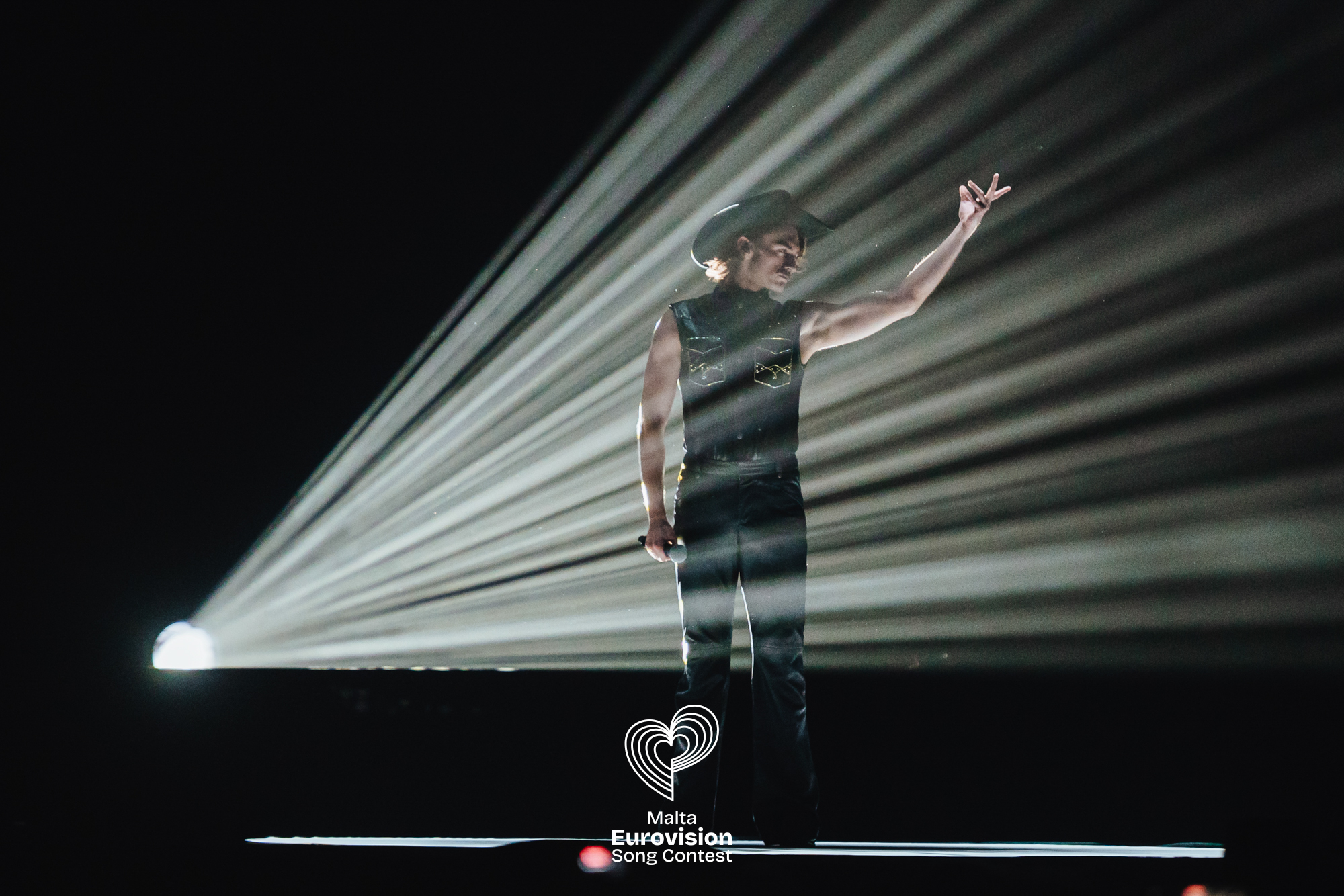
Aidan’s “Bella” is a jazz-leaning, retro-styled, multilingual ballad. It is not radical, but it is clearly positioned. It sits outside the dominant contemporary dance-pop lane that usually fills national finals. Within a Eurovision semi-final, where pop and dance-pop routinely make up around 60–70% of entries, a jazzy, classic-influenced ballad would likely fall into a minority bracket, perhaps 10–15% of the field at most.
Historically, that should put “Bella” in a favourable position. Not because it is guaranteed to win, but because juries in particular tend to reward songs that are legible, vocally strong, and stylistically distinct from the pack. In previous editions, this is exactly the zone where Malta has struggled to place, not due to quality, but due to over-alignment with the middle.
By contrast, Matt Blxck’s “The Flute” leans into ethno-dance territory. In recent Eurovisions, dance-pop and club-oriented tracks collectively make up the single largest genre cluster. Even when flavoured with ethnic instrumentation, these songs often compete directly with ten or more similar entries. In a typical year, that could mean occupying 25–35% of the field.
That does not mean “The Flute” is not a crowd-pleasing song. The song is very likeable, as evidenced by the strong televoting results. But it makes it crowded, and as a result, it needs to rely heavily on televote momentum and extravagant staging to stand out.
Seen through this lens, “Bella” aligns with the long-run Eurovision logic of minority positioning. “The Flute” aligns with the logic of mass appeal inside an already saturated lane. The uncomfortable conclusion is this: Eurovision does not reward only being good. It rewards being different and good.