
Manwel Dimech’s newspaper; il-Bandiera tal-Maltin
On 8 January 1898, a new weekly newspaper appeared in Malta that would test the limits of colonial tolerance, clerical authority, and public complacency. Its title, Il-Bandiera tal-Maltin (The Flag of the Maltese), carried a deliberate symbolism. Manuel Dimech, the paper’s founder, editor, and sole driving force, intended his publication to serve as a moral and intellectual standard around which a different Maltese society might rally
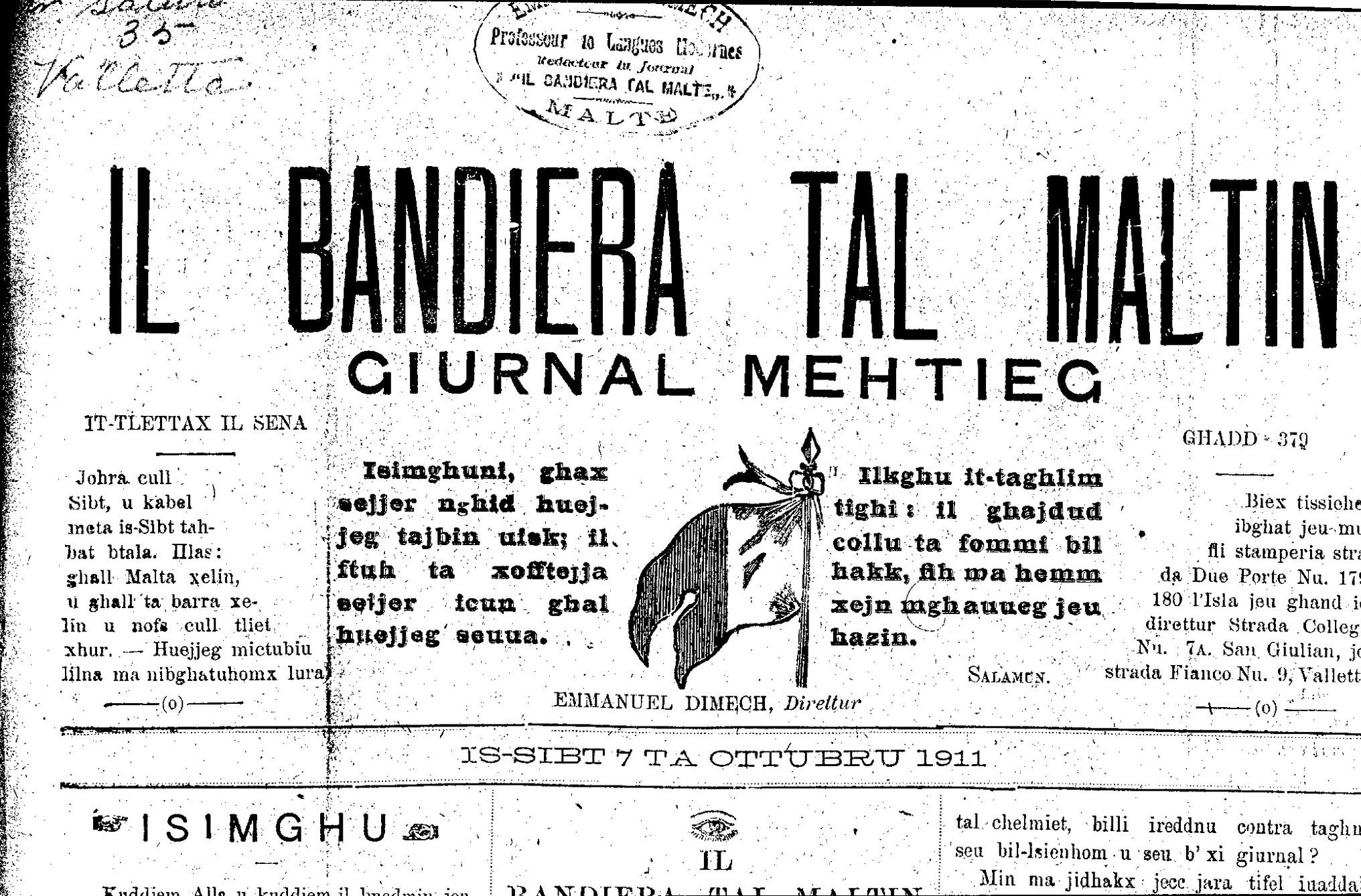
The newspaper - Bandiera tal-Maltin
The paper opened with a declaration that left little room for ambiguity about its purpose. It would be “a rod to the oppressor and a shield for the oppressed”. It would seek to eradicate from Malta and from the Maltese mind those ideas and customs that had become “worthless in this time and age” and replace them with “new ideas of light and progress”. In the political and social context of late nineteenth-century Malta, this was not rhetoric designed to flatter authority. It was a challenge to the most powerful people in the country.
Although censorship had been partially relaxed from 1839 onwards, public debate remained constrained by informal power, social pressure, and fear of reprisal, especially from the church. Newspapers existed, but many aligned themselves either with colonial administrators or with established political factions, which at the time represented the elite of society. Dimech’s decision to launch an independent weekly in Maltese, aimed explicitly at educating and mobilising the lower classes, placed him outside these conventions.
Dimech himself was an unlikely publisher. Born in Valletta in 1860, he did not come from wealth, status, or formal academic training. Much of his early life was marked by hardship. He grew up in poverty and spent a significant part of his youth in the prison. Those years shaped him profoundly. Prison was where he learned languages, read widely, and encountered both the brutality of the system and the possibility of intellectual awakening. English Protestant pastors, fellow inmates, and books became his informal university.
Corradino was also where Dimech witnessed at close range the failures of colonial justice. The execution in July 1894 of Rosario Mizzi, known as Il-Lajs, whom Dimech believed to be innocent, left a deep and lasting impression. For him, Il-Lajs became a symbol of the Maltese people themselves. Poor, voiceless, and expendable within an unjust system sustained by administrative corruption and institutional indifference.
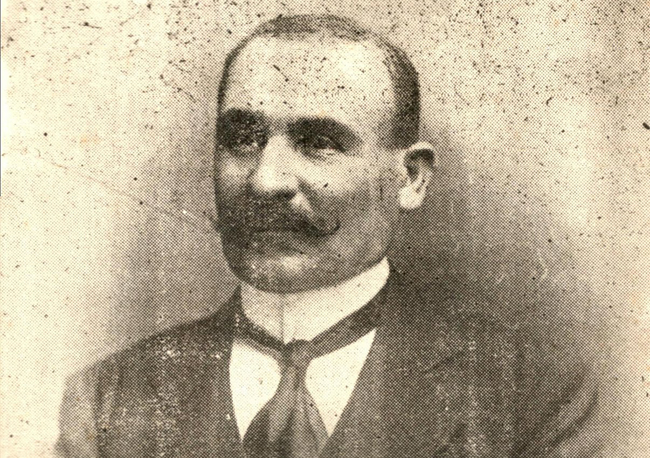
Manwel Dimech
After his release in February 1896, Dimech did not immediately enter public life. For nearly two years he lived quietly, teaching privately, preparing grammar texts, and reflecting. Education, rather than agitation, was his instinctive vocation. When Il-Bandiera tal-Maltin finally appeared in January 1898 it was because Dimech had come to see the printed word as the most effective instrument available to him. A newspaper could educate, provoke, and reach beyond the walls of classrooms or meeting halls.
The early issues of Il-Bandiera tal-Maltin, particularly those published between 1898 and 1905, reveal a publication with a clear purpose. The paper addressed poverty, ignorance, corruption, abuse of power, and moral hypocrisy. It criticised both the colonial administration and the Catholic Church, accusing the latter of colluding in a system that kept the Maltese population obedient and ignorant rather than enlightened. These positions were not framed as abstract ideology but as practical questions of daily life, justice, and dignity.
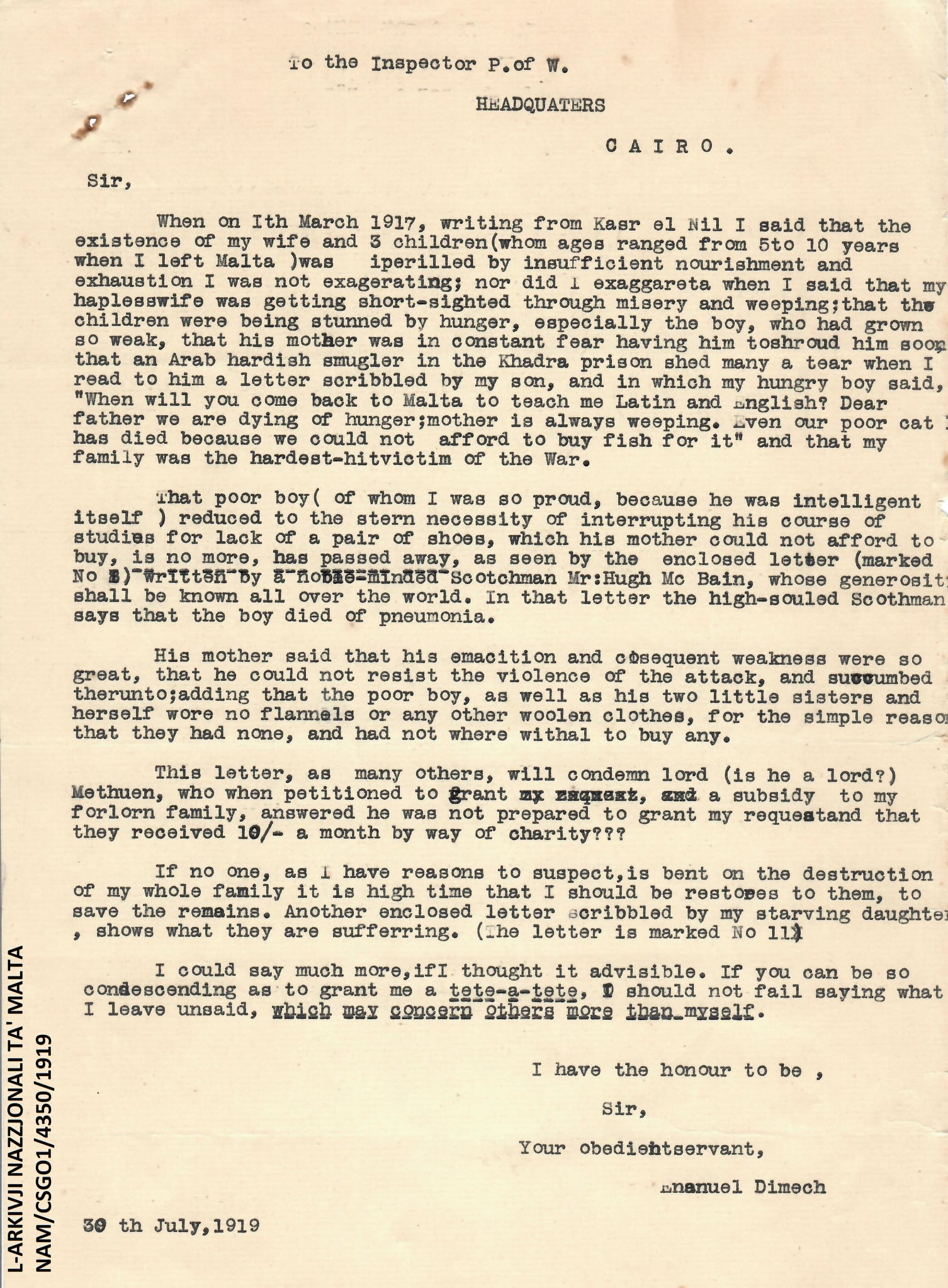
Manwel Dimech wrote several letters asking for assistance to his family
Despite modest circulation, estimated at between 500 and 800 copies, the paper’s influence extended beyond its readership. It unsettled authorities precisely because it articulated grievances that many recognised but few dared to express. Publication was not continuous. Between 1905 and 1911, Dimech lived abroad, primarily in Italy, and Il-Bandiera ceased publication. When he returned, the political climate had hardened. In 1911, the bishop of Malta condemned the paper and excommunicated Dimech for his writings. Such measures were intended to silence him. Instead, Dimech resumed publishing, continuing until September 1914, when he was forced into permanent exile.
By then, Il-Bandiera tal-Maltin had already given rise to something more ambitious. In 1911, Dimech founded Ix-Xirka tal-Imdawlin (The Assembly of the Illuminated), a society intended to embody the values his paper had long promoted. It was, in essence, a vision of a republican Malta, articulated decades before it became a realistic prospect.
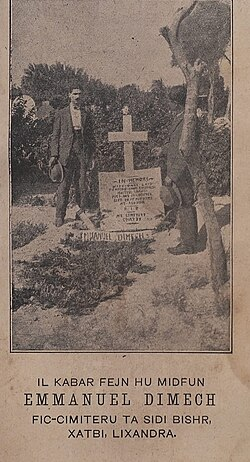
The final years of Dimech’s life were spent in exile in Alexandria, where he died in 1921 in poverty and isolation. Yet the ideas he articulated outlived him and his paper. Il-Bandiera tal-Maltin treated journalism as a form of education and education as a form of political action.
A century after its first publication, the significance of Il-Bandiera tal-Maltin lies less in its immediate impact than in the long shadow it cast. It demonstrated that Maltese public life could be shaped from below, that criticism could be grounded in moral argument, and that print could serve as a tool of emancipation rather than control.
On 8 January 1898, a single individual with limited means chose to confront power with words. In doing so, Manuel Dimech expanded the boundaries of what could be said, imagined, and demanded in Malta. That legacy continues to resonate long after the paper itself fell silent.
With Spunt, we consciously try to draw from the same tradition that animated Il-Bandiera tal-Maltin. The belief that writing can bring education which can be transformative. Like Dimech, we see journalism as a civic tool and explanation as a form of accountability. More than a century on, the challenges are different, but the principle remains unchanged: a society advances only when ideas are shared clearly, critically, and without fear.