
Malta adopts the Euro
At midnight on 1 January 2008, the Maltese lira officially ceased to be the country’s currency, replaced by the euro after more than three decades as the unit of an independent state. The moment was marked by a simple withdrawal of the first euro banknotes from an ATM in Valletta.
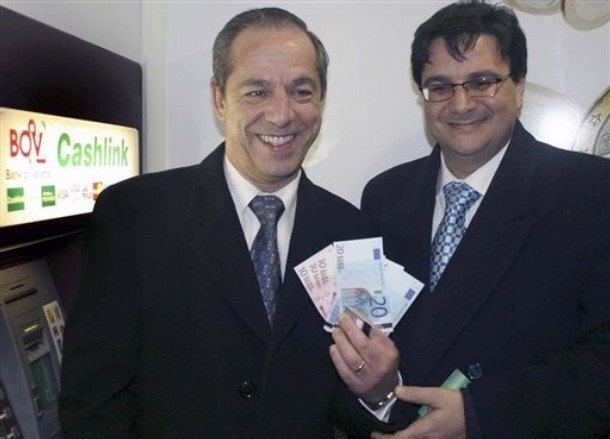
Prime Minister Lawrence Gonzi, Finance Minister Tonio Fenech and Central Bank Governor Michael C. Bonello were among those present as Malta crossed the threshold into the euro area. The three were to withdraw the first Euro banknotes from the ATM, a meant to be a nice symbolic gesture to commemorate the moment. The event was broadcast live and it produced an instantly memorable footnote to history when the Bank of Valletta ATM briefly failed to dispense cash. The bank later blamed an alignment fault caused by the large crowds surrounding the machine. Maltese humour offered other explanations.
Beyond that moment, the first day of the euro was largely uneventful. Most businesses were closed for the public holiday. The old Maltese currency remained legal tender until the end of January, allowing households and retailers time to adjust. Banks reported unusually high ATM usage, with more than €2.4 million withdrawn across Malta and Gozo by late afternoon, around ten times the normal volume. Some machines temporarily ran out of cash as demand exceeded expectations.
Everyday details captured the transition. Stationers sold newspapers to customers paying with Lm20 notes, effectively acting as informal exchange points. Church collection trays still filled mostly with Maltese coins. Children opened euro starter kits bought in advance, swapping plastic school tokens for real money.
Yet behind that calm lay the culmination of more than three years of fiscal adjustment, institutional reform, and political calculation. By adopting the euro, Malta did not simply replace banknotes and coins. It embedded itself permanently within Europe’s monetary architecture and accepted a new set of economic constraints that would shape policy for decades.
The decision to see Malta adopt the Euro
The decision was formalised on 10 July 2007, when the ECOFIN Council approved Malta’s entry into the euro area with effect from the start of the following year. In a statement welcoming the move, Jean-Claude Trichet, then President of the European Central Bank, described euro adoption as the logical continuation of Malta’s accession to the European Union in 2004. It would enlarge the euro area to 15 member states, with Malta and Cyprus joining simultaneously.
For European institutions, this was another step in the gradual expansion of the single currency. For Malta, it was a structural choice about how a small, open economy should anchor itself in an increasingly integrated European market.
Euro adoption was never optional
When Malta joined the EU on 1 May 2004, it did so as a member state with a derogation. This meant that euro adoption was deferred, not avoidable. Unlike the United Kingdom or Denmark, Malta had no opt-out. The obligation to adopt the single currency was written into the accession framework itself.
The only question was timing. To qualify, Malta had to meet the Maastricht convergence criteria on inflation, public finances, exchange rate stability, and long-term interest rates. These conditions were important policy shifts, particularly in a country where fiscal deficits and inflationary pressures had become entrenched in the early 2000s.
The most critical milestone came on 2 May 2005, when Malta entered the Exchange Rate Mechanism II. The Maltese lira was fixed against the euro at a central parity of 0.429300. That rate held throughout the ERM II period and later became the irrevocable conversion rate.
Until then, the lira’s value had been calculated using a weighted basket of currencies including the US dollar, sterling, and the euro. Joining ERM II meant abandoning discretionary exchange rate management in favour of discipline and predictability. It also meant that any loss of competitiveness would have to be addressed through domestic policy rather than devaluation.
From that point onwards, euro adoption became less a political aspiration and more a technical question of compliance and credibility.
Fiscal discipline and institutional credibility
Meeting the Maastricht criteria required sustained effort. Malta had to bring down its public deficit and demonstrate that inflation was under control. This was not simply about satisfying Brussels but about convincing markets, households, and businesses that euro adoption would be stable and permanent.
Academic and institutional analysis at the time highlighted that public confidence was the single most important variable in a successful changeover. Legal continuity of contracts, clear conversion and rounding rules, consumer protection measures, and effective communication were all essential to prevent confusion or mistrust.
The Central Bank of Malta became the operational centre of this process. Its role expanded from managing a national currency to preparing for integration into the Eurosystem. Information technology systems were adapted, legal frameworks reviewed, and reporting structures aligned with European Central Bank requirements.
This preparation mattered because euro adoption is irreversible. Once conversion rates are fixed and membership confirmed, there is no formal mechanism for exit. The credibility of the entire system depends on that permanence.
A big-bang transition
Unlike the first wave of euro adopters, Malta did not experience a long transition period. By 2008, the euro already existed as a physical and electronic currency. Maltese authorities therefore opted for a “big-bang” changeover, introducing euro cash and scriptural euro simultaneously.
This approach concentrated risk into a short period but avoided prolonged dual currency circulation. From a policy perspective, it reduced costs, limited uncertainty, and avoided a drawn-out adjustment for retailers, banks, and consumers.
Dual circulation of the lira and the euro continued until the end of January. Old currency could still be exchanged at banks and the Central Bank thereafter. Children opened euro starter kits purchased by their parents. Churches collected mostly Maltese coins in the first days. Stationers found themselves acting as informal exchange points.
The Maltese lira faded not with a shock but with routine.
A seat at the table, with limits
From the first day of euro membership, Malta became part of the Eurosystem. The Governor of the Central Bank of Malta, took his place on the ECB’s Governing Council. Formally, his vote carried the same weight as those of governors from far larger economies.
This equality of voice is one of the defining features of the euro area. Monetary policy is set for the euro area as a whole, with price stability as the primary objective. National conditions matter only insofar as they affect the aggregate.
For Malta, this meant accepting that interest rates and liquidity conditions would reflect developments in the euro area rather than local cycles. The loss of monetary autonomy was real, but it was also largely theoretical. Even before euro adoption, Malta’s policy choices were constrained by openness, capital mobility, and the need to maintain exchange rate credibility.
Euro adoption formalised an economic reality that already existed.
Why the euro made sense for Malta
The economic logic behind euro adoption rested on scale and structure. Malta is a small, highly open economy dependent on trade, tourism, and external capital flows. Currency volatility imposed costs on businesses and households alike. Transaction costs mattered disproportionately.
By joining the euro, Malta eliminated exchange rate risk with its main trading partners, reduced conversion costs, and anchored inflation expectations to the ECB’s mandate. For investors, it reinforced Malta’s reputation as a predictable and rules-based jurisdiction.
The trade-off was fiscal discipline. Membership of the euro area places greater emphasis on sound public finances, not only through formal rules but through market scrutiny. For a country with limited room for policy error, this discipline was seen as a stabilising force rather than a constraint.
A longer monetary perspective
Seen in historical context, euro adoption was less radical than it appeared. For most of its history, Malta did not issue or control its own currency. Carthaginian coins circulated from the sixth century BC. Roman coinage replaced them after 218 BC. Sicilian standards followed. Under successive rulers, the islands used the currencies of those who governed them.
Even under the Knights of St John, foreign coins circulated alongside local issues. During the first decades of British rule, the legal currency mix included Spanish dollars, Sicilian dollars, French francs, and sterling. It was only in 1855 that sterling became the sole legal tender.
Malta’s period of full monetary independence was brief. Decimal coinage was introduced in 1972. The Malta pound, later renamed the Maltese lira, circulated as the sole currency of an independent state for just over three decades. In that sense, the euro was not a rupture but a return to Malta’s historical position within wider monetary systems.