
The greatest earthquake to hit Malta
In the course of Malta’s history, earthquakes were not unknown, and small tremors sometimes passed without much notice, but on Sunday 11 January 1693 the islands experienced what is consistently described as the most terrible and most damaging earthquake ever recorded locally, an event that left the population shaken not only by the physical destruction it caused, but by the sense of helplessness it created.
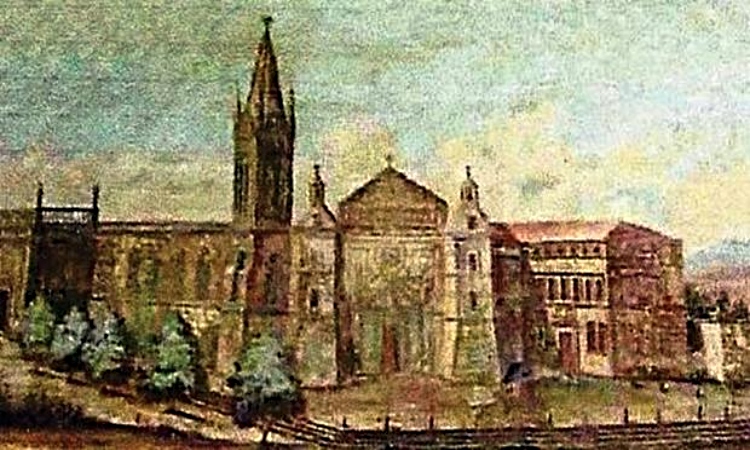
A painting showing how the Mdina Cathedral looked before reconstruction
The disaster did not arrive suddenly, because two days earlier, on 9 January, Malta felt smaller shocks which later accounts describe as foreshocks, unsettling but not damaging, and then, on the afternoon of the 11th, around 2pm, the great tremor arrived with a force and duration that people would struggle to describe except through vivid comparisons, with one eyewitness saying it sounded like the noise of an approaching cart that became more frightening the closer it seemed to come, while another description recorded by Notary Marc’Antonio Brancati spoke of a loud crack like a thunderbolt roaring in the distance but drawing nearer as the earth heaved and the house swayed and shook.
Even though the epicentre was in Sicily, the shock was strong enough in Malta to cause widespread damage across the main settlements, to the point that later reports stated that in Valletta there was not one house that did not require some repair, and while many structures needed only minor attention, others were considered dangerous enough to require urgent intervention, including buildings whose façades had detached or whose structural cracks suggested imminent collapse if another tremor followed.
Mdina, already affected at the time by depopulation and neglect in parts, suffered particularly hard, with significant damage reported across the city and the cathedral partially collapsing, and even accounts that note the cathedral’s pre-existing disrepair still treat the earthquake as the moment that turned weakness into ruin, accelerating decisions that were already being considered and transforming long-term plans into immediate necessity.
In Gozo, damage was especially associated with Victoria and the Castello, where assessments described severe impacts, and one of the most striking examples repeated in later summaries is the collapse of the dome of St George’s church in Victoria, an image that captures how even monumental religious architecture could fail under stress that no builder was designing for in the seventeenth century.
The sea itself was also drawn into the story, because Canon G.P. Agius de Soldanis wrote that at Xlendi Bay the sea retired for a great distance from the shore, while rocks broke away from precipices such as at Ġebel Sannat, descriptions that sit alongside the broader historical record that this earthquake generated a tsunami that affected the Sicilian coastline and was also reported in Gozo, reminding us that this was not only a shaking of buildings, but a larger Mediterranean event with multiple hazards unfolding together.
What makes the Maltese experience of 1693 unusual, and in a way even more psychologically revealing, is that despite extensive damage, no direct fatalities were recorded locally, yet fear still reached the level of mass panic, with accounts saying that many people spent nights outside their homes in tents or makeshift shelters, and that those in Cottonera even took refuge on galleys and other ships in the harbour, as if being on water felt safer than trusting stone walls that had already shown they could crack.
In Sicily, by contrast, the scale was catastrophic, with historical estimates placing the death toll in the tens of thousands, and later summaries commonly citing figures that range from around 50,000 to 60,000 and beyond, a difference that underlined for Maltese observers that the earthquake was part of a far wider tragedy, even if the islands escaped the absolute worst of it.
The reaction of the authorities and the Church was immediate and deeply shaped by the worldview of the time, because the earthquake was not treated as a technical problem to be managed, but as a moment of common danger that demanded moral response, and Grand Master Adrien de Wignacourt ordered the temporary closure of law courts, halted forms of entertainment, and cancelled carnival celebrations, while religious rites intensified across the islands, with the Holy Sacrament exposed at St John’s and acts of fasting and public penitence encouraged, and with devotion particularly directed to St Paul, whose role as protector and intercessor became central in the population’s attempt to interpret and survive what had happened.
Bishop Davide Cocco Palmieri ordered extended expositions of the Holy Sacrament across the diocese, processions were held in Mdina and elsewhere, and on 25 January, the feast of the Conversion of St Paul, parishes participated in a general procession to St Paul’s Bay followed by High Mass and benediction, while in Gozo similar manifestations were directed mainly to St Ursula and an annual votive procession was instituted, all of which show that what followed was not merely repair work, but an island-wide effort to restore a sense of order through ritual when the physical environment had proven unpredictable.
Yet the earthquake’s long-term legacy was not only spiritual, because it also reshaped Malta’s built environment and its architectural timeline, most famously through the loss of the medieval cathedral in Mdina and the later construction of the present cathedral between 1697 and 1703 to the designs of Lorenzo Gafà, with wider remodelling of parts of Mdina later associated with François de Mondion during the magistracy of António Manoel de Vilhena, meaning that a moment of sudden destruction became one of the events that pushed Malta’s urban story into a new phase.
The 1693 earthquake is therefore remembered not just as the day Malta shook, but as the day the islands were reminded that safety can be conditional, that fear can spread even without loss of life, and that one afternoon of seismic violence can leave marks that remain visible in stone, in memory, and in the rituals communities build to make sense of the forces they cannot control.