
Energy Subsidies in Malta - What happens if they end?
Malta’s fixed energy price policy has become one of the defining economic choices of the last three years. It kept inflation lower than in the euro area, stabilised household purchasing power, and protected firms from the most extreme effects of the global energy shock. The question that now matters is simple. What would happen if Malta started to withdraw this support. The answer is a set of trade offs where when taken together, they give a consistent picture of what Malta would face without the current regime.

Malta’s fixed-price energy policy has kept inflation far below what it otherwise would have been. The Central Bank’s modelling estimates that without the subsidy, aggregate consumption inflation would have risen by around 2 percentage points higher during the peak of the energy shock. For low-income households the effect would have been even sharper. Their inflation rate would have climbed by more than double that of higher-income households, reflecting the much larger share of energy in their consumption basket. This means that in 2022–2023, when many EU states saw energy-driven inflation running at 10 to 20 percent, Malta largely avoided the spike because the increase never reached household bills.
The cumulative effect over time is equally striking. Had Malta allowed energy prices to adjust to global levels, simulations show that the combined hit from energy, transport and pass-through into services would have produced significantly higher inflation for several consecutive years, with the peak front-loaded into 2022–2024.
Instead, headline inflation in Malta remained one of the lowest in the euro area, averaging 2 to 3 percentage points lower than the EU median. This gap is not marginal. It shaped wage negotiations, slowed the erosion of real incomes, and prevented the type of cost-of-living crisis experienced elsewhere. In short, the subsidy did not reduce inflation by a few tenths of a percent but prevented a full-scale inflation shock from entering the Maltese economy in the first place.
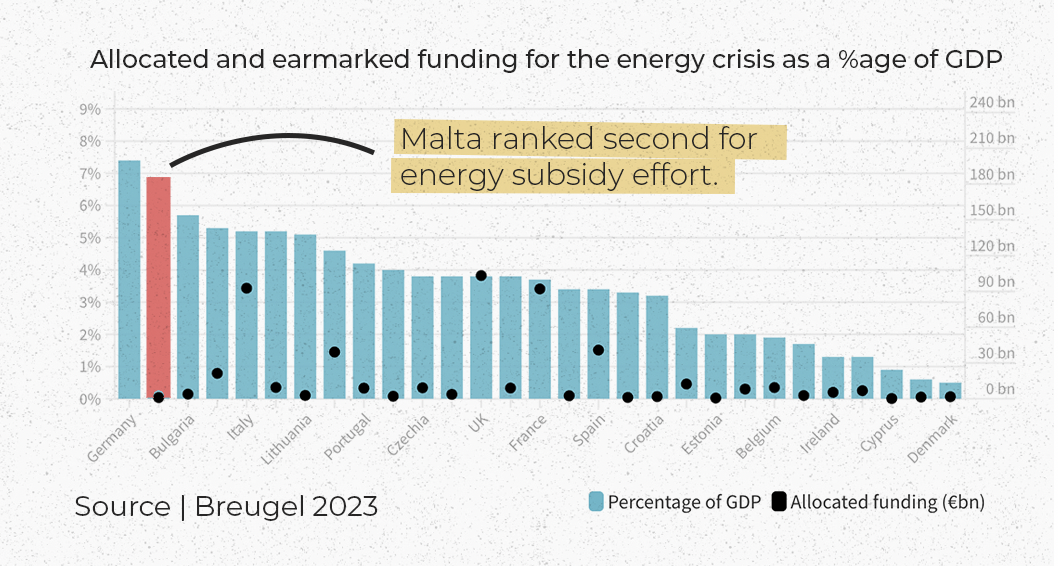
But the cost was not negligible. Malta ranked second in Europe for the scale of its subsidy effort relative to national output. A fixed price regime is expensive by design because it supports every unit of energy consumed. This raises a critical policy question; What happens when Malta begins to withdraw this support? And what is the least damaging way to do so?
Scenario 1: Immediate End of the Energy Subsidy in Malta
An abrupt removal of energy subsidies in Malta would deliver the fastest improvement in the fiscal balance, but at the cost of the sharpest economic shock. The first effect is inflation. Energy prices would revert to market levels overnight. This would feed directly into household and business costs and then cascade into the broader price level. The Bank estimates a pronounced but temporary inflation bump concentrated in the early quarters following the exit.
The second effect concerns growth. Faced with higher bills, households reduce discretionary consumption and firms delay investment. GDP does not collapse into a deep recession, but the economy enters a visible period of softness. Consumption, one of Malta’s key drivers, falls as disposable incomes are squeezed.
There is a third effect as well. Public finances improve because subsidy expenditure stops immediately. However the gain is not equal to the full amount spent under the fixed price regime. Lower consumption and lower profits reduce VAT, income tax and corporate tax receipts. Once these offsets are taken into account, the net fiscal improvement remains positive, but smaller than the headline figure.
Finally, there is the environmental dimension. A higher energy price prompts firms to shift toward greener investment, whether through efficiency upgrades or a reconcentration of production choices. Households, by contrast, are less likely to follow this path. The immediate fall in disposable income reduces the financial space needed for home-energy installations or major efficiency upgrades.
In short, a sudden exit is fiscally effective but economically disruptive. It achieves rapid budget repair at the cost of a short-term shock to inflation, consumption and investment.
Scenario 2: A Gradual Taper
A slower withdrawal of energy subsidies in Malta results in a more controlled adjustment. Prices rise in steps rather than in a single leap. Inflation increases, but without a major spike. Firms adjust their spending plans more slowly and households receive more time to adapt.
Growth softens, but it does not stall. Because the adjustment is spread over several years, consumption and investment fall gradually rather than abruptly. This reduces the risk of a sharp break in economic momentum or a disorderly shift in behaviour.
The fiscal gains take longer to materialise. Expenditure on the subsidy falls year by year, and the associated revenue shortfall from weaker demand also unfolds gradually. The net improvement remains positive, but it arrives later.
The social cost, however, is not eliminated. It is simply distributed over time. Energy still becomes more expensive and low-income households remain the most exposed. For this group, energy comprises a far larger share of their consumption basket. The Central Bank shows that without the subsidy, poorer households would have faced an inflation rate roughly twice as high as wealthier groups during the peak of the shock. That asymmetry does not disappear under a taper. It becomes more manageable, but it remains substantial.
The Distributional Challenge
Across both scenarios, one constant emerges. Low-income households experience the greatest strain. This is not because they consume more energy in absolute terms. Rather, it is because energy represents a larger proportion of their essential spending. When prices rise, they cannot simply adjust by deferring purchases or relying on savings. The impact is immediate and regressive.
Higher-income households, by contrast, are less exposed to price changes because energy occupies a smaller share of their budgets. Yet they benefit more under a fixed-price regime because a blanket subsidy gives equal support per unit of energy consumed. Heavier users receive more euro value in total, regardless of income or need.
This structure is one reason the Central Bank argues for targeted support rather than a universal price freeze. Protecting basic consumption for vulnerable groups is fiscally efficient and socially fairer. At the same time, removing artificially low prices on high-consumption usage restores incentives for efficiency and accelerates the shift toward cleaner energy sources.
A Crossroads for Malta
The benefits of the past are undeniable. The fixed price regime shielded households, stabilised inflation and sustained consumption when global energy markets were in turmoil. But now Malta faces the next phase of the policy cycle. The question is not whether the subsidy worked when it was introduced. It is whether the country can sustain the same mechanism in a more stable environment without compromising fiscal health and long-term competitiveness.
Removing the subsidy, quickly or slowly, inevitably shifts part of the energy cost back to households and firms. The extent of the shock depends on timing and design. A sudden end produces a jolt. There is a better argument for a tapered approach out of it but one must accept the opportunity costs that exist. Inflation will rise and straining low-income households more than any other group.