

Can the reintroduction of apprenticeships help fertility rates in Malta?
By any measure, Malta faces one of the most severe demographic challenges in Europe. Currently, fertility rates in Malta are roughly 1.08 children per woman, far below the replacement level of 2.1, the country is entering a period in which population ageing, labour shortages and pressure on the public finances become structural rather than cyclical concerns. In his latest budget, Finance Minister Clyde Caruana placed the issue at the centre of national debate. A multi-year package of tax cuts for families with children aims to ease financial pressures and signal political commitment to reversing the trend.
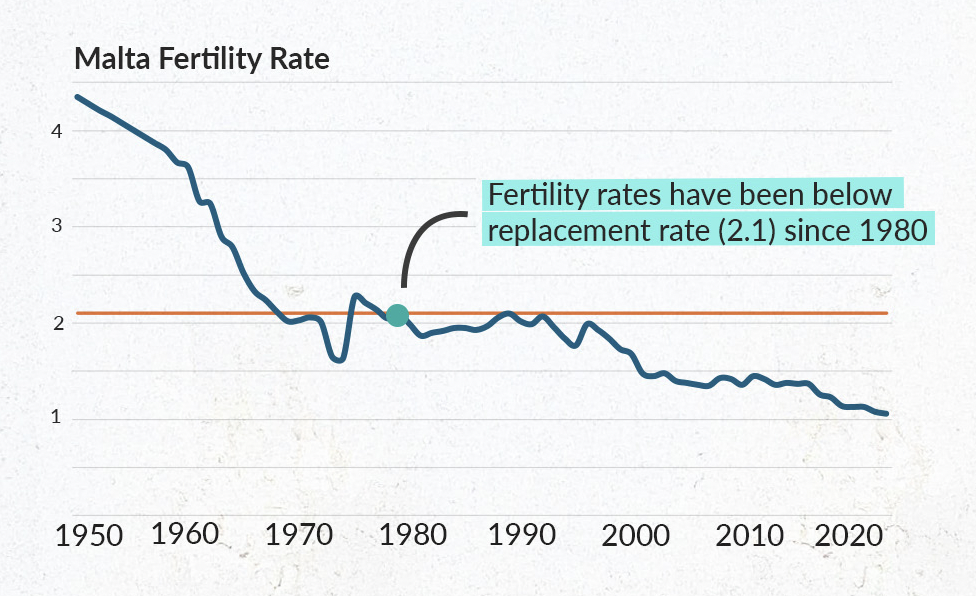
These interventions matter. But as decades of European experience suggest, financial incentives alone rarely shift birth patterns in any significant way. The gap between the number of children people say they would like to have and the number they actually have tends to reflect not only economic barriers but also the way young adults move through education, employment and housing. The decisive variable, increasingly, is timing. When people feel ready to start a family is often more cultural than financial.
The Extended Adolescence Problem
Across Europe, even generous family benefits have not halted fertility decline. OECD studies point to modest effects on the cost burden of raising children, but limited impact on the age at which people feel secure enough to have them. This gap is particularly visible in small, high pressure economies where housing costs rise quickly, labour markets demand specialised skills and young adults spend longer in formal education.
Malta fits this pattern closely. The socially accepted life sequence for many young Maltese is linear: enter university, find a partner, graduate, obtain a full-time job, save, build a career, purchase a home and only then consider children. In theory this progression provides security. In practice it compresses major life milestones into a narrow window. A student who finishes university at 22 or 23 often enters adulthood with no savings, limited work experience and an increasingly unaffordable property market. By the time financial and personal readiness converge, many reach the age of 30, which is also the average age of first birth in Malta.
This postponement has consequences. Countries where first births occur later tend to have lower completed fertility, a pattern highlighted in demographic studies by the Council of Europe. A delay of even two years can reduce the likelihood of having a second or third child, not because people change their preferences but because the biological and economic constraints tighten.
A Structural Reform That Targets Timing
One proposal that could help Malta reshape the early trajectory of adulthood is a revival of a system the country once used but abandoned in the late 1990s. For several years, the University of Malta operated a six-month study and six-month paid apprenticeship model in selected faculties. Students divided their year between classroom learning and employment. It was gradually phased out as academic structures aligned more closely with the Bologna Process.
A modernised version of this arrangement could be reintroduced to reflect the needs of today’s economy. Rather than delaying the first meaningful entry into the workforce until the age of 22, students could begin working at 18, accumulating experience, networks and savings while still completing their degrees. Exposure to real workplaces often accelerates learning and relevance, potentially allowing some degrees to become more targeted and efficient.
The benefits would extend beyond education. Earlier work experience brings earlier financial stability. It allows young adults to build credit histories, secure better loan terms and engage with the housing market sooner. It also reduces the risk that students graduate into jobs they dislike, only to pivot careers at a point when they feel they should already be established. Businesses would gain from a more stable pipeline of younger workers, and Malta could ease its well-documented labour shortages without relying solely on foreign labour.
In an economy facing technological disruption, with AI reshaping entry level roles, an alternating study-work structure can also provide a smoother transition. Rather than entering an increasingly automated job market with no experience, students would accumulate three full years of structured employment by the time they graduate.
A Modest Shift With Potentially Large Demographic Effects
No single reform can reverse a fertility decline of this scale. Yet shifting the average age of financial and personal readiness from 30 closer to 28 would align Malta more closely with countries that maintain higher birth rates. An apprenticeship model alone cannot deliver that shift, but it could contribute to it by expanding the margin in which young people can settle into work, save for housing and plan a family.
The policy’s appeal is that it targets the timing issue directly rather than relying on financial transfers to offset costs. When young adults feel chronically unprepared for parenthood, even generous incentives struggle to alter behaviour. Structural reforms that shorten the transition to adulthood may offer more meaningful long term impact.
Towards a National Strategy for Fertility Rates in Malta
A sustainable fertility strategy cannot depend on a single measure, whether tax cuts or education reforms. It requires a coordinated national plan that connects housing affordability, childcare availability, labour market flexibility, gender equality, education pathways and cultural expectations. Malta has not approached a demographic issue with this level of strategic cohesion since the early development frameworks of the post independence period. The scale of the challenge now requires similar ambition.
Caruana’s budget has righfully placed fertility at the centre of public debate. The next step is to broaden the discussion. Apprenticeships are not a magic solution, but they illustrate the kind of structural diagnosis that Malta must undertake. Reforms that reshape the early years of adulthood may ultimately do more to encourage family formation than any single financial incentive. The task is to create conditions where young people can pursue their aspirations without delaying the choice of having children beyond the point where intentions and reality diverge.
The risk is clear. Without a shift in both policy and mindset, the demographic pressures Malta faces today will intensify tomorrow. The opportunity is equally clear. A national strategy that brings together universities, employers, policymakers and communities could begin to reverse the trend and place the country on a more secure long term path.